
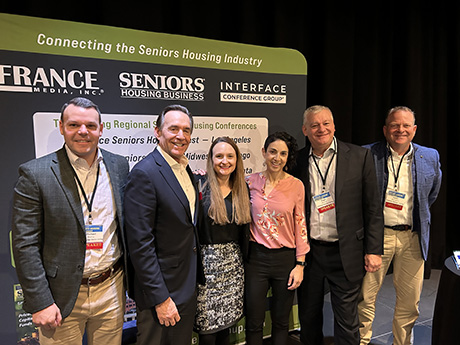
By Hayden Spiess
PHILADELPHIA — Economic challenges persist, but there is an abundance of optimism surrounding the seniors housing industry heading into 2026, according to industry professionals who gathered at Live! Hotel Philadelphia for InterFace Seniors Housing Northeast on Dec. 4. The ninth annual event attracted more than 240 attendees.
Editor’s note: InterFace Conference Group, a division of France Media Inc., produces networking and educational conferences for commercial real estate executives. To sign up for email announcements about specific events, visit www.interfaceconferencegroup.com/subscribe.
The positive outlook permeated the “CEO Power Panel,” which featured five senior living executives opining on the state of the industry.
“We’re very lucky to be in this business,” enthused Keven Bennema, co-founder and CEO of Charter Senior Living and one of the panel participants.
Led by panel moderator Laura Cambria, senior vice president of KARE, the session also included Larry Cohen of Trustwell Living, Erin Hennessey of Health Dimensions Group, Roger Bernier of Chelsea Senior Living and Michael Morris of Willow Ridge Senior Living.
Panelists offered observations and insights for navigating the current landscape. Following are five key takeaways from the session.
1) Make the Secondary Primary
Bennema, whose company ranked as the 39th-largest operator in the 2025 edition of the ASHA 50, remarked that developing in secondary markets can be advantageous, especially given the current headwinds.
According to Bennema, Charter’s primary development partner is very bullish on markets of this nature as well. “There are markets that most people can’t find on a map that have screamingly positive demographics,” elaborated Bennema. “Not everyone moves to Florida or Arizona or the South.”
He has been pleasantly surprised by the level of success that can be achieved in secondary markets. “It was a big education for me because I always thought that you needed to be in primary markets to have success.”
Charter’s current portfolio includes communities in Moline, Illinois, and Jackson, Tennessee, for instance.
Bennema acknowledges that the landscape for development is not currently ideal. In addition to the still-elevated construction costs and interest rates, he cited the difficulty of obtaining programmatic equity (a long-term capital commitment for a series of investments) as a primary struggle.
“It’s been kind of a slugfest to convince investors that they should invest in new development,” he explained. “There are still a number of distressed properties, and the pricing of those communities has been arguably a little better as an investment than putting money in a new development and having to wait for three or four or five years before you can get some cash out.”
Nevertheless, Charter is enthusiastic about development in select markets, and Bennema reports that the company has about six projects lined up.
Hennessey, CEO of Health Dimensions Group, shares Bennema’s enthusiasm for secondary markets. “We have one project that we’re just starting, and it’s in a secondary market,” she revealed. “Keven and I both know the benefits of some secondary and even tertiary markets.”
“You can be surprised, sometimes, at what demand is there and the price point you can get,” Hennessey continued. “We have a lot of success in those markets.”
2) Use AI Wisely
Once communities are open, they can be helped along by the use of artificial intelligence (AI), according to Bernier, president and COO of Chelsea Senior Living. “The sales and marketing side, especially the marketing side, is using AI for demographics studies and pinpointing where your residents are coming from and where you’re spending your money,” he said. “We’re definitely starting to use [AI in that context], and it works.”
Morris, president and CEO of Willow Ridge Senior Living, is also enthusiastic about AI. “I see a lot of opportunity in the budgeting and modeling side of the business with AI,” he said. “If I had a nickel for every time we built a model or set of projections for an opportunity that never happened, I’d be pretty well off. That process can be automated in a way that leverages AI and saves you time, and then you’re not exhausting your resources on something that never happens.”
Bennema cautioned that while AI can be very useful, especially on the clinical side, it is important to exercise discretion and not just apply new technology heedlessly. “We have to make sure we kind of crawl before we walk with AI,” said Bennema.
3) Seek Alignment in Partnerships
Moderator Cambria, who brought a vendor’s perspective to the session, also asked panelists how they go about choosing their business partners.
Morris argued that selecting the right partners is paramount. “Relationships are the heart of everything we do in the seniors housing industry,” he asserted. Morris and other participants shared that it is therefore important to seek partners that are a good fit.
“Partnerships are always wonderful on the front end, and then you learn about the difficulties of partnerships when stuff starts to go bad,” mused Bennema. “You have to perform as an operator and build trust with your capital partners, but your capital partners also have to have your back.”
“We’re subject matter experts in the field in which we work, and investment partners relying on us to do what we’re hired to do is critically important,” echoed Morris.
Morris also shared that in the early days of Willow Ridge, he discovered the consequences of being less discriminating in accepting management contracts. “I took on a project where the interests of the capital partner were directly conflicting with the operator,” he explained.
Bernier added that philosophical alignment is as important as financial alignment. “It really has to be the right fit,” Bernier noted. “When you work with folks that are only interested in the rate increases, they’re never asking how the care is or how things are going or how resident satisfaction is or even coming to see the buildings, which is important.”
4) Affordability is an Issue
Cohen, CEO of Trustwell Living, on the other hand, is a frequent fixture at his company’s communities. “I visit our buildings around the country frequently,” said Cohen.
He also divulged that one of his main concerns about the industry is the struggle of affordability. “As much as we see the need for more units and look at the construction numbers, we have to filter that through the lens of affordability,” Cohen asserted. “It’s a much smaller population that has the resources [for senior living] and that is part of our challenge.”
Hennessey shared that bringing costs down when developing communities can help keep the price point reasonable once the properties are opened. One way Health Dimensions Group achieves this is by partnering with a general contractor and a developer. “When you have the operator, owner, developer and general contractor, you’re able to get development done a little more reasonably,” she explained.
Bernier shared that the issue of affordability concerns him as well. “The affordability aspect is something that keeps me up at night,” he confided.
5) Optimism Abounds
On the other hand, Cohen is encouraged by the demographic tailwinds for senior living. “Everyone always talks about the wave of aging adults, and over the last 30 or 40 years, it was too early in the cycle to know what that real demographic wave would be. But now we finally have it.”
Cohen’s best cause for optimism, though, is not the demographic data or industry fundamentals, but rather the performance of Trustwell’s own communities. “I see positive energy in our communities from both our staff and our residents,” he shared at the conclusion of the panel. “We do a good job. We have 41 buildings in 14 states, and our average Google review right now is 4.75 [out of 5] stars.”
For his part, Bernier is heartened by an improving labor pool. “Different folks and younger folks are coming into the industry and working — it’s an exciting time,” proclaimed Bernier. “People are looking at seniors housing as an opportunity for a career.”
Morris himself was once a young person entering the field of seniors housing. He recalled that he began his career at age 15 as a dietary aide at an assisted living facility. Focusing on his passion for senior living keeps him optimistic and helps him remain grounded in the purpose of the industry, Morris said. “We’re helping seniors, we’re helping family members, and we’re doing good things.”