
By Jane Adler
The simple answer to who’s buying and selling is everyone. REITs are rapidly acquiring senior living properties. Global asset managers with long track records in the sector are bulking up. Private equity funds are deploying capital, and new investors are entering the space.
On the sell side, investment managers are repositioning portfolios to achieve regional synergies. Non-core assets are being shed.
Single-property owners or those with small portfolios see rising prices as a good time to sell. Owners of truly distressed properties are eager to exit, though the pool of troubled communities continues to narrow.
“The market has been super active,” says Kyle Hallion, managing director at Chicago-based Blueprint Health Care Real Estate. “It’s a great time for buyers and sellers.” Hallion is based in the firm’s office in Louisville, Kentucky.
Highly favorable market fundamentals are driving transaction activity. The long-awaited and huge baby boomer generation at about 70 million strong is finally starting to hit the age where they may need senior living housing and care. Fallout from the pandemic has eased. Occupancies and rents are rising. Net operating income is trending higher.
New development has been constrained, and seniors housing investment returns are outpacing other commercial real estate asset categories. What’s more, capital is readily available.
REIT Standouts
Some REITs are benefitting greatly from strong stock price gains over the past 12 to 24 months and a relatively low cost of capital. The stock price for Welltower Inc. (NYSE: WELL) closed at $188.16 on Thursday, Jan. 15, 2026, up from $126.59 a year earlier, a 49 percent increase. The Toledo, Ohio-based company is the largest healthcare REIT with a market cap of approximately $129.1 billion.
Over the same period, the stock price for Chicago-based Ventas Inc. (NYSE: VTR) — the second largest healthcare REIT with a market cap of approximately $36.8 billion — rose from $58.02 to $76.92 per share, a 33 percent increase.
Meanwhile, private equity funds are attracting capital from investors eager to ride the aging population wave. And the debt markets, mostly constrained over the last several years, are opening up again.
“Deals are delivering win-win outcomes for buyers and sellers,” says Hallion. “We expect these trends to continue for another few years.”
Inside the Numbers
Through the first three quarters of 2025, seniors housing and care deal volume totaled $13.8 billion, according to MSCI, a market data and analytics company based in New York City. Seniors housing accounted for nearly $10 billion in sales, while nursing care totaled $3.8 billion.
For the same period in 2024, seniors housing and care deal volume totaled $8.5 billion, including $5.5 billion in seniors housing transactions and $3 billion in nursing care deals.
Property and portfolio sales for all of 2024 totaled about $14.4 billion, which pales in comparison to 2021 when deal volume reached $20.8 billion. The five-year low point was 2020 at about $10.6 billion.
According to the National Investment Center for Seniors Housing and Care (NIC), headquartered in Annapolis, Maryland, the all-time peak year for transactions was 2011. Sales volume totaled $26.6 billion, driven by large portfolio deals from the public REITs.
NIC says transaction volume hit a low during the Great Recession, logging less than $3 billion in both 2008 and 2009.
Here are some recent notable acquisitions:
Welltower invested $14 billion to acquire more than 700 high-quality seniors housing communities, comprising over 46,000 units in the U.K., U.S., and Canada. The U.S. portfolio of luxury seniors housing assets is in the Northeast, including Boston and Westchester County, New York.
Ventas agreed to acquire a six-property portfolio from Harrison Street and B2K for about $600 million. Ventas also reported acquisitions of $2.2 billion year-to-date through October 2025.
Brookdale Senior Living (NYSE: BKD), based in Nashville, Tennessee, is in the process of acquiring 41 communities — properties that it currently leases — for $610 million.
Omega Healthcare Investors (NYSE: OHI), headquartered in Hunt Valley, Maryland, acquired a 45-property portfolio of care homes in the U.K for about $344 million.
Sonida Senior Living (NYSE: SNDA), a Dallas-based owner, operator, and investor is acquiring and merging with CNL Healthcare Properties (CHP), a public non-traded REIT. The deal is valued at $1.8 billion and is expected to be complete in 2026.
CareTrust REIT (NYSE: CTRE), based in San Clemente, California, recently closed a series of transactions totaling $437 million. The properties consisted mostly of skilled nursing facilities and several assisted living communities.
Market shows positive momentum
Major seniors housing owners are selling properties too, pruning or rightsizing their portfolios based on investment strategies, the expiration of hold periods and plain old bad timing.
Blackstone (NYSE: BX) continues to liquidate its $1.8 billion seniors housing portfolio in a retreat from the market. The New York City-based investment firm started to acquire the properties in 2016-17, well ahead of age wave of baby boomers.
The firm has sold 70 of the 90 properties in its portfolio and is in talks to sell the remainder. Losses are reported to be more than $600 million. According to The Wall Street Journal, Blackstone acquired value-add properties that proved difficult to turn around, particularly as a result of the pandemic, a cautionary take for other investors that might not recognize the complexity of senior living operations.
Stars Are Aligned for Investors
With market fundamentals clearly on the rise, it appears now would be an optimal time for seniors housing investment. “The market has tremendous positive momentum,” says Aron Will, vice chairman of CBRE Capital Markets, who is based in the Houston office of the global commercial real estate services firm.
What’s more, demographics rule. The first baby boomers turn age 80 in 2026. About 4 million will reach age 80 each year from 2026-2044. Age 80 is often the point at which seniors begin to consider or need senior living options.
New construction remains constrained. Supply is not keeping up with projected demand. NIC reports that only 17,000 units of independent living and assisted living inventory was under construction as of the third quarter of 2025, the lowest level since early 2012.
Existing property prices generally remain below the replacement cost of new construction, spurring competition for the current inventory of communities.
Construction costs are expected to increase by 4 to 6 percent over the next 12 months, according to an April 2025 report prepared for the American Seniors Housing Association by The Weitz Company, a full-service cnational onstruction firm.
Investment returns are strong. In the third quarter of 2025, seniors housing posted a total unlevered return of 2.88 percent, the highest among all major property types tracked by the National Council of Real Estate Investment Fiduciaries (NCREIF). Over the first nine months of 2025, senior housing’s total return reached 7 percent.
The healthcare REITs have cash on hand for acquisitions and are outperforming other sectors, with total returns year-to-date through December 5 of nearly 37 percent, according to NAREIT.
“Healthcare REITs with larger senior living portfolios are benefiting from strong sector performance,” says Will of CBRE. “This trend may be reflected in their stock prices, driven by the perception of embedded upside and sustained growth from 2026 to 2033 as baby boomers age and limited new supply enters the market over the next three to five years.”
Lenders Come Out of Hibernation
The availability of debt plays a role in the uptick of transaction activity, according to Courtney Nickels, COO of healthcare at Artemis Real Estate Partners, a private investment firm based in Chevy Chase, Maryland. Nickels’ office is in Atlanta.
“Lenders have come back into the market,” says Nickels. Artemis owns 16 senior housing assets and also provides debt capital typically in a subordinate or mezzanine structure.
Artemis recently purchased Atria at Foster Square, a 155-unit seniors housing community in Foster City, California. It was built in 2026 by Atria, which will continue to operate the community.
Floating-rate debt costs have declined by about 65 basis points over the last 12 months, thereby reducing borrowers’ interest expenses, according to Will at CBRE. At the same time, debt funds are programmatically active for the first time in the sector’s history, offering competitive pricing. Debt availability and pricing at agency lenders Fannie Mae and Freddie Mac have also improved, as has liquidity within the bank market.
Cap rates are compressing, according to Will. The highest quality trophy seniors housing assets are trading at a cap rate in the high 5 percent range, with most deals landing in the 6s.
“As more capital comes into space in the next 18 to 24 months, the herd mentality will drive cap rates down,” says Will. “Buying high-quality assets now with outsized rental rate growth potential and no new development makes sense.”
Buyers Prefer a Continuum of Care
Of course, not all investments are equal. “The market has wide disparities,” says Jeff Binder, senior managing director at Wheaton, Illinois-based Senior Living Investment Brokerage. Binder operates out of the firm’s St. Louis office.
Binder has brokered the sale of single-asset distressed rural communities for $25,000 to $50,000 per unit as well as communities with price tags of $400,000 to $500,000 per unit. He characterizes the buyer pool as fragmented, with most of it driven by regional companies. Portfolios with a mix of distressed and performing assets are often split up when brought to market.
“Buyers are looking for a property with a continuum of care,” says Binder.
That typically includes independent living and assisted living as well as memory care, or alternatively, assisted living and memory care. Stand-alone memory care has a shallow pool of buyers, he emphasizes.
The REITs and private equity firms are seeking newer properties, less than about five years old, run by strong regional operators, sources say. About one-third of the national seniors housing inventory is 25 years old or older, a vintage unlikely to appeal to the new consumer who wants a large unit and lots of amenities. “The baby boomer consumer doesn’t want a 400-square-foot studio apartment,” insists Will of CBRE.
Newer buildings in prime locations attract multiple bids and sell fast, brokers say. High-end communities in desirable places can receive 10 or more offers in a competitive multi-round bidding process. “So many groups want the same thing,” says Blueprint’s Hallion.
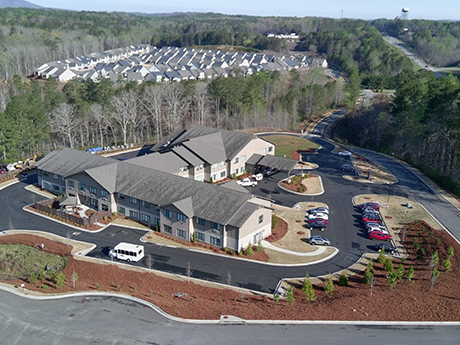
For example, Blueprint recently arranged the sale of The Lodge at Stephens Lake located in the upscale town of Jasper, Georgia, about 45 minutes from Atlanta. The 2022 vintage property was built and owned by a local developer as part of a master-planned community. The Lodge at Stephens Lake features 83 units of independent living cottages, assisted living and memory care. It is adjacent to a large active adult development.
At the time the deal closed in September 2025, the occupancy rate had approached 95 percent with annualized revenue of $4.7 million and a 30 percent EBITDAR (earnings before interest, taxes, depreciation, amortization and rent), according to Blueprint.
Sabra Health Care REIT (NASDAQ: SBRA) purchased the property for $22 million, or $265,000 per unit. The property included an opportunity to expand the community with another 30 assisted living units. In the third quarter of 2025, Sabra reported total seniors housing investments year to date of $421.9 million. Sabra is based in Tustin, California.
Investor demand for the Stephens Lake property was strong, according to Hallion. He noted that the 30-day marketing campaign generated multiple initial rounds of offers from both public and private investors.
Quality Operators in Demand
While many buyers are seeking the same types of properties, they’re also looking in the same places. Buyers prefer properties in high-growth primary markets, and in particular in Texas, Florida, Southern California, and the Washington, D.C. metro area, sources say. Select submarkets in other big metro areas are also coveted.
“From an asset perspective, there are ‘haves’ and ‘have-nots’,” observes Brian Sunday, managing director at Boston-based AEW, an investment firm with a long-standing history of seniors housing ownership.
Sunday explains that the “haves” are owners with properties that can attract a deep buyer pool and generate a bidding war. The “have-nots” are owners of older vintage properties in less desirable locations and with poor performance records.
“If you don’t have what people want, it’s a harder sales process,” says Sunday. He adds that the AEW strategy focuses on submarket dynamics when selecting properties to purchase.
According to published sources, AEW recently bought Inspira Arrowhead in Glendale, Arizona. Funds managed by Fortress Investment Group sold the 165-unit property for about $65 million. During its 18 months of ownership, Fortress drove up occupancy from 89 percent to 94 percent and improved net operating income by 35 percent.
Operators are taking an outsized role in purchase decisions. Savvy investors know a strong operator with a proven track record can make the difference between success and failure, especially when a community still has vacancy.
“Our vetting process of operators is rigorous,” says Phil Kayden, chief investment officer at Chicago-based Health Wave Partners.
The investment firm, which was launched in June 2025, is backed by Sydney, Australia-based Macquarie Asset Management. “We want to make sure we are working with best-in-class operators.” Kayden and John Cobb, CEO of Health Wave, are both industry veterans who were recruited from Blueprint.
Health Wave’s preference is to keep existing operators in place after a purchase, emphasizes Kayden. He encounters a number of off-market opportunities in which the operator with a joint-venture interest in a property is given time to find a capital partner rather than hire a broker. “It gives the operator a line of sight into keeping the management contract,” he says.
Who will be buying and selling in 2026? The answer remains everyone, according to Todd Lindblom, national director of seniors housing at the Milwaukee office of Marcus & Millichap. Likely participants include mom-and-pop owners, institutions, REITs, regional operators, private equity firms and new entrants. “The pipeline is full,” he says.
Fresh capital from array of sources fuels uptick in transaction activity
New investors are helping to drive the surge in seniors housing M&A activity. The sector’s strong real estate fundamentals are attracting multifamily developers, family offices, private equity funds, wealthy individuals and investors shifting out of distressed commercial real estate segments.
Azure Partners recently made its first seniors housing acquisition with the purchase of Cypress Court in Escondido, California. The community features 76 independent living and 72 assisted living residences. Kisco Senior Living sold the property. New York City-based Azure owns mostly multifamily and retail properties. JLL Capital Markets arranged the sale along with a Freddie Mac 10-year loan. The sales price was not disclosed.
“The seller is pruning selective, non-strategic assets,” says Dan Baker senior director at Chicago-based JLL who operates out of the firm’s San Diego office. “The buyer’s interest was buoyed by the excellent performance, operational simplicity relative to other opportunities, familiarity with the submarket and the retention of the incumbent operator.” Northstar Senior Living will continue to manage the community.
Other investors see opportunity in senior living. Stacked Stone is a private equity investment fund in a joint venture partnership with Santa Rosa, California-based Praxis Capital. Praxis launched a $50 million healthcare fund in 2025. Kent Eikanas, who started Stacked Stone Ventures in 2023, was previously CEO at Summit Healthcare REIT.
Stacked Stone acquisitions are projected to total $120 million in 2025, according to Eikanas. Stacked Stone recently purchased the Oak Pointe portfolio for $71 million. It includes seven properties in Missouri and is being managed by New Jersey-based Viva Senior Living. The broker was Jeff Binder, senior managing director in the St. Louis office of Senior Living Investment Brokerage (SLIB), which is headquartered in Wheaton, Illinois.
The seller of the Oak Pointe portfolio was Clear Path Senior Holdings, the developer of the properties. “We strategically sold the Oak Pointe portfolio,” says Jim Eisenhart, general partner and managing principal at Aligned Equity Group, Clear Path’s investment arm. “It was a good time to sell and it sets us up for more expansion.”
Clear Path and Aligned Equity are both based in St. Louis. Aligned Equity owns 11 other senior living properties in Ohio and Michigan.
The Oak Pointe properties are located in small secondary and tertiary markets. Aligned Equity owns 11 other senior living properties in bigger markets, a better fit for its strategy going forward, says Eisenhart.
For now, the rush of new investors into senior living is expected to continue. Offering advice to the newcomers, SLIB’s Binder emphasizes that senior housing has complex operating requirements. “The best thing they can do is align with a known and successful operator,” he says. “No one gets a free pass. — Jane Adler
— This article originally appeared in the December 2025-January 2026 issue of Seniors Housing Business magazine.