
By Jane Adler
The latest senior living design trends are forward-looking, aimed at attracting the up-and-coming generation of older consumers. These future residents don’t identify with the stereotypes of “old age.” They’re active and focused on staying healthy.
They mostly prefer more modern designs and open interiors that flow into one another so people can connect. They expect spaces that are welcoming and authentic, not unlike those they enjoyed in their former homes.
In response, architects and interior designers are reimagining senior living spaces around the themes of hospitality, wellness and connection. Common areas are flexible and serve multiple purposes. Gone are the designated craft rooms that sit idle most of the day.
Units are getting bigger, and more homelike. Many apartments have a washer and dryer. Some assisted living units even feature full kitchens. The latest technology is a given.
At the same time, architects and designers are finding creative ways to stay within budget as construction costs continue to rise. Careful thought is being given to how best to maximize visual and emotional impact.
Lobbies and common gathering spaces are budget priorities. First impressions count. Owners and operators also want designs with a distinct character that align with their brand.
Against this backdrop, here are five key architecture and interior design trends to watch in 2026.
1. Modern designs with a distinct identity — Seniors housing has come a long way from the days of Victorian-style buildings with wraparound porches, ornate gables and decorative trim. Developers, architects and consumers alike favor more contemporary designs with clean lines, sleek materials and bold forms.
“Buildings have a cleaner, more modern feel,” says Dora Kay, vice president at Moseley, an architecture firm based in Fairfax, Virginia. She adds, however, that the architecture of the surrounding community will determine how modern a senior living building can look.
High-rises in dense urban neighborhoods generally feature a more modern exterior than those in the suburbs. Moseley designed Benchmark at Alexandria, a 10-story high-rise in a new urban mixed-use development in Alexandria, Virginia.
Originally conceived as an office building with a curved exterior, the project was reimagined by Moseley as a senior living community featuring 89 assisted living and 26 memory care units.
To accommodate more residents, first-floor space previously earmarked for retail was converted into apartments. The curved exterior was revamped to feature a modern brick and metal panel façade with large windows.
“First impressions are very important,” says Kay. “We want visitors to have that ‘wow’ feeling upfront.”
The interiors, designed by Austin, Texas-based StudioSix5, reflect warm colors and textured materials. Erin Rinehardt, associate at StudioSix5, adds, “Wellness-driven, biophilic design is curated throughout the community to create a sense of place and connection between the interior and exterior architecture.”
While adopting a more contemporary aesthetic, designers are putting the owners’ signature stamp on projects to showcase their brands.
For example, Kensington Bethesda is a new project designed by Moseley. The project is owned and operated by Kensington Senior Living, headquartered in Reston, Virginia. The $90 million, eight-story project offers 121 assisted living and memory care units. The community stands out with an arched window roof and sloped ceilings on the interior.
“The project has flair and character,” says Kay. “Operators like showing that they can call it their own.”
Rachelle DeGeorge, founding principal at Studio 121, an interior design firm based in Nashville, Tennessee, says brand storytelling through design is becoming a priority. Her firm is designing the interiors for Corso Chevy Chase, a luxury senior living rental community in Chevy Chase, Maryland, that Galerie Living and Community Three are slated to break ground on later this year.
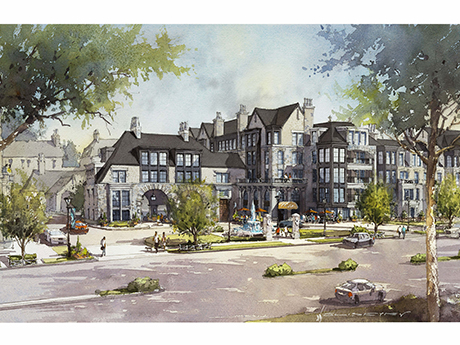
The project has a British cottage style with a modern twist. “Anything goes,” says DeGeorge.” It all depends on the story the client wants to tell.”
2. Livable, flexible spaces — Owners and operators want their buildings to have a distinctive “vibe.” The goal is to design dynamic common areas that feel alive with resident activity. Half-empty rooms can undermine the perception of vibrancy and engagement.
“We want to create spaces where the new consumer can envision their lifestyle,” says Janet Meyer, principal at Baltimore-based BCT Design Group. Gone are the big multipurpose rooms used for only an hour a day, she explains.
Another common misstep: designing dining spaces large enough to seat everyone at once, even though they’re rarely full and look empty.
“It’s really about tightening up spaces so people can interact,” says Meyer. She adds that scaling down the overall common area footprint also helps to control costs.
Today’s designs emphasize flexibility. A bar area might serve as a coffee bistro in the morning, a place for afternoon card games, and a gathering spot for happy hour in the evening. Multiple dining venues are still widespread, but with a twist.
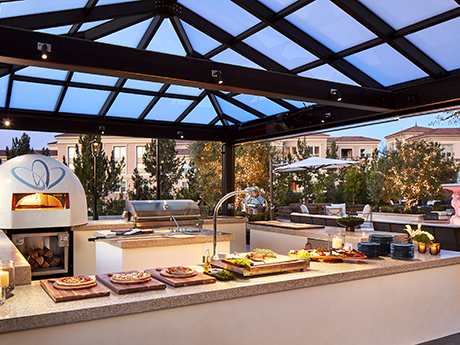
Popular additions are pizza ovens, juice bars and outdoor kitchens. Areas can be set aside for cooking displays and private family gatherings.
“Spaces should make people feel like they belong,” says Shannon Remaley, principal at Meyer Design, an architectural and interior design firm headquartered in Philadelphia.
The best designs take cues from their surroundings. Perhaps art is central to the broader community, and that theme can then be carried throughout the development.
“We need to think about and get to know the consumer,” adds Remaley.
Thoma-Holec Design handled the interiors at MorningStar at Old Town in Fort Collins, Colorado, a mixed-use community with all levels of care. The building includes a bank and a restaurant. MorningStar at Old Town is situated in the old part of Fort Collins near Colorado State University.
The university’s colors, green and gold, were used throughout the project to reflect the local community and make residents feel at home, says Laura Pask, director of operations at Mesa, Arizona-based Thoma-Holec Design.
Residents who enjoy wine have a wine-tasting room with their own wine lockers. And since Fort Collins features a big arts scene, the community spotlights works by local artists to bring personality and warmth to the spaces.
3. Wellness as a lifestyle — The new consumer believes wellness is a lifestyle. “It’s not a new trend, but it’s becoming more and more important in new and renovated developments,” says Meyer’s Remaley.
Today, wellness includes the physical, mental and social aspects, she notes. “It’s a holistic approach to wellness.”
Wellness spaces now hold a prominent place within buildings, often clustered together to create a destination. The fitness center might be adjacent to a spa, juice bar, pool or therapy areas. “Some clients include healthcare into their wellness areas, bringing doctors on site,” says Remaley.
Direct Supply Aptura is creating a wellness-focused design for the luxury clubhouse renovation at Cypress of Hilton Head, an LCS-managed community on Hilton Head Island in South Carolina.
Programming will emphasize mobility, balance and mental health. A wellness concierge will provide personalized services to help residents develop exercise programs and maintain overall well-being. Outdoor views will be incorporated into the design.
“From the moment you walk in, the focus is on experiential design,” says Rebecca Jourdan, senior lead interior designer at Direct Supply/Aptura, which is based in Milwaukee, Wisconsin.
She explains that experiential design creates engaging, memorable spaces rather than traditional activity rooms. Areas are designed to foster a sense of hospitability and destination.
Another Direct Supply Aptura project, Oak Hill at St. Davids in Wayne, Pennsylvania, is described as a wellness-focused life plan community that Rockwell Development Group is expected to break ground this year.
A lower-level gathering space in the wellness center will feature interactive seminars and a wellness concierge to help residents blend fitness into their daily routine.
Facilities will include a yoga studio, pool and sauna. Outdoor walking trails will encourage movement and a connection to nature. “Wellness is a lifestyle,” says Jourdan.
StudioSix5 is the interior design firm for Vivante Turtle Creek in Dallas Texas. Developer Nexus Cos., based in South Coast Metro, California, recently broke ground on the 20-story, 193-unit senior living community for which HKS is the architect. Nexus has three similar properties in Southern California.
Vivante Turtle Creek will offer health and wellness programming, a wellness center with an on-site doctor’s office along with a physical and occupational therapy clinic.
“The idea is to integrate wellness into all aspects of the resident’s life,” says Dean Maddalena, president and founder of StudioSix5.
4. Amenities as social connectors — Designers are increasingly creating amenities that encourage socialization with a touch of hospitality. At StudioSIX5, the design process begins with the creation of “characters” who might live in a proposed community.
For example, the character might be a 75-year-old widow who wants to find more opportunities to socialize.
The design team then fills in the lifestyle details of the character. What kind of restaurant does she like? Where does she shop? What are her favorite activities?
“It helps us set up the kind of environment that character, our potential customer, would want to live in,” says Maddalena.
At Vivante Turtle Creek, residents will enjoy spaces where residents can socialize with family and friends, including a small bowling alley. A bar area will feature game consoles for the grandchildren that the staff can also use for parties. “It’s a very socially active space,” says Maddalena.
Designers are also placing more focus on entertainment and play. Amenities include golf simulators, bowling alleys and even antique car displays, according to Meyer’s Remaley.
“Developers and operators are asking designers to find something to differentiate the building from the competition,” she says.
Outdoor spaces have evolved into essential amenities that need to be usable. Designers are finding ways to bring the outside in and to create outdoor spaces that invite residents to go outside and socialize.
“There’s a blurring of the lines between outdoors and indoors,” says Remaley. “Activities can flow easily from inside to outside.”
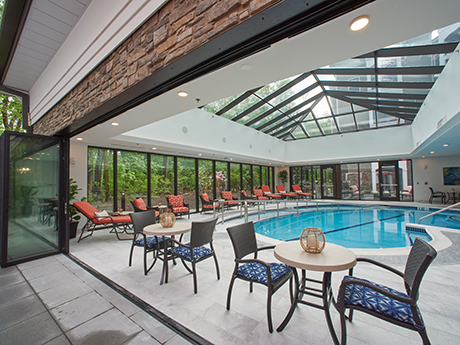
Designers are including flexible glass doors that connect indoor and outdoor spaces. Dining rooms can open onto patios when the weather is nice.
Fitness rooms use similar doors to link yoga and Pilates studios to outdoor areas. Even indoor pools connect seamlessly to outdoor decks. “We’re seeing an exciting evolution,” says Remaley.
At Brightview Hunt Valley in Hunt Valley, Maryland, which opened in 2024, the assisted living amenity spaces are located near resident apartments on the second floor. Residents have easy access to an outdoor terrace furnished with a shade structure and comfortable seating.
“When you’re frail, getting on an elevator just to go outside can be challenging,” says Meyer of BCT Design Group.
5. Big units, more tech and more choices — Residents of high-end senior living properties are typically coming from large houses. They expect their new apartments to feel equally spacious.
They’re looking for generous floor plans with dedicated dining areas, modern kitchens, balconies and lots of storage, sources say. Independent living and even some assisted living units now include washers and dryers. “It speaks to the residents’ independence,” says Remaley.
Two-bedroom units and one-bedroom units with dens are popular. Studio apartments are getting bigger.
There’s a strong push for neutral interiors. Once popular grey hues are being replaced with warm earth tones. Today’s hot color is “grange,” says architect Maddalena — a combination of grey and brown, something like beige.
New customers, and their adult children, expect units to be equipped with the latest technology. In the near future, residents will use their phones to control lights, appliances and in-unit HVAC systems. Building engineers will be able to monitor systems and determine when a refrigerator filter needs to be replaced, for example.
“Developers must build in the infrastructure to be able to accommodate all those systems in the future,” says Maddalena. “Buildings should have scalable Wi-Fi systems.”
Customization is a growing demand. Just as home builders give buyers some choices on finishes, senior living developers are offering more choices and personalization.
“Residents coming from custom homes expect to have more choices,” says Pask at Thoma-Holec Design. Her firm is working with a local community in Arizona that offers different finish packages for certain units. Options are available for lighting, cabinet colors, floor types and bathroom tile. “The biggest change over the last couple years is the amount of resident involvement on design decisions,” says DeGeorge at Studio 121.
Between HGTV and online tools like ChatGPT, residents joining a new life plan community arrive with lots of opinions about everything from seat heights to fabric selections, explains DeGeorge. “Residents want to know what will improve their lives.”
— This article originally appeared in the October-November 2025 issue of Seniors Housing Business magazine.