
By Matt Valley
PHILADELPHIA — With new development in the seniors housing and care space slowed to a trickle despite strong market fundamentals and pent-up demand, what will it take for the dam to break and release a wave of new construction?
Editor’s note: InterFace Conference Group, a division of France Media Inc., produces networking and educational conferences for commercial real estate executives. To sign up for email announcements about specific events, visit www.interfaceconferencegroup.com/subscribe.
The short answer is that there is no silver bullet. There are several financial, operational and market factors that must be take into consideration, which together form what Matthew Whitlock, chief investment officer and managing director of the seniors housing fund at Boston-based Berkshire Residential Investments (BRI), likes to refer to as “a complicated matrix.”
“As much as I like to repeat what I heard earlier today, that 10,000 people turn 80 every day and that will [continue] for the next eight years, that’s one piece of it. There’s another piece of it, which is that since COVID, construction costs are up 39 percent. And they’re not going down. Labor costs are up. That’s a component of it,” remarked Whitlock during the investment panel discussion at InterFace Seniors Housing Northeast in Philadelphia on Dec. 4.
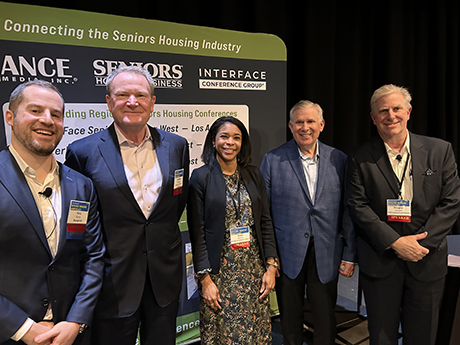
The daylong conference, which took place at Live! Hotel Philadelphia, attracted more than 240 industry professionals. Joining Whitlock on stage were Kory Buzin, panel moderator and senior director at Blueprint Healthcare Real Estate Advisors; Ken Assiran, managing director, seniors housing, Capital Funding Group; Douglas Cooper, partner at SHA Capital Partners; and Shani Walter, managing director of business development at Omega Healthcare Investors (NYSE: OHI).
Groundbreakings Few and Far Between
Annual inventory growth in the third quarter of 2025 was 0.7 percent compared with annual absorption of 3.5 percent, according to NIC MAP. Less than 1,400 units opened in the third quarter across the top 31 primary markets tracked by the data and analytics firm.
Cooper of Chicago-based SHA Capital Partners, which focuses exclusively on seniors housing investment and development, said that the supply-demand fundamentals are off the charts. “I’ve been in the development world for over 40 years, and this is the best setup for development I have ever seen in my career.”
The third-quarter 2025 data from NIC MAP stood out to Cooper. Of the 140 markets tracked by the data provider, 84 had zero development projects. Even many of the large primary markets had only one or two development projects.
“It is staggering to me how little development is going on. The amount of new supply is near an all-time low. So, this is just a fantastic time for investors, limited partner investors in particular, to wake up and smell the coffee,” said Cooper, who concentrates primarily on seniors housing development in the Mid-Atlantic.
A New Breed of Customer
Today’s 80-year-olds are vastly different customers than their predecessors from the Silent Generation and Greatest Generation, Whitlock pointed out. The Baby Boomers grew up with radios in their cars and Johnson’s No More Tears Baby Shampoo.
“They want more space, higher ceilings, crown moldings, granite counter tops, stainless steel appliances. They want the programming to be re-examined,” said Whitlock, adding that today’s seniors housing product also features a great emphasis on technology.
“That’s fundamentally a different product than that which I was acquiring and developing at Brookdale [Senior Living] in 1997. So, you can make the argument that a lot of the existing product is irrelevant,” stated Whitlock.
Savvy buyers and operators will figure out ways to breathe new life into those obsolete communities, Whitlock believes. For instance, they may make wholesale changes in the way they operate these communities and lower rents to attract the middle market.
“But the development of the new stuff is going to require imagination, and it’s going to require input from the incoming baby boomer population,” he said.
The bottom line is that seniors housing development requires a premium for investors, emphasized Whitlock. “There needs to be a premium not only for the risk associated with a highly operationally intensive business, but also with the risk that things can go wrong when you develop something. This [development process] is five years before we see any money.”
Lenders Emerge from Hibernation
Assiran of Baltimore-based Capital Funding Group, primarily a healthcare lender, said that activity in the debt and equity markets is definitely on the rise. Twelve to 18 moths ago, there were very few capital providers and lenders that were active, he noted. “We had the market not completely to ourselves, but there wasn’t a lot of competition. Well, that’s changed.”
The aftereffects of COVID still linger, however, Assiran pointed out. “There’s a lot of value-add investing that’s going on. We invest in or lend to groups that are really heavily into value-add.” The operational and financial distress caused by the pandemic created opportunities for investors seeking underperforming assets that could be acquired at a discount and improved in exchange for a healthy return. In some cases, seniors housing properties are trading hands at a 30 to 40 percent discount to replacement cost.
There is some nonrecourse lending that’s starting to occur, added Assiran, a sign that lenders are growing more comfortable with the overall health of the seniors housing sector. That said, the capital markets aren’t embracing new development, he noted.
“There’s still some headwinds in development dealing with operating expenses or overall returns,” explained Assiran. “Is the return there for a new development deal versus an acquisition? And is it really the time to be doing new development?” Those are the salient questions.
As valuations increase and cap rates compress, Assiran believes more new ground-up development will take place. Currently, what development that is occurring is more on the high end, he said.
Overseas Investors Come Calling
BRI has a fully deployed seniors housing development fund that it launched in 2018. Today it includes 10 assets and about 1,200 units. Whitlock said there is a tremendous amount of interest from investors in the U.S. and abroad looking to deploy capital in the seniors housing sector.
“Our capital is raised by an internal capital markets team, and what we’ve noticed is that more and more capital is coming from overseas, specifically the Middle East and Australia,” noted Whitlock.
The challenge for BRI, which does not have an operating platform in seniors housing, is to provide a risk-adjusted return for seniors housing investors that is superior to that of multifamily. “Our capital coming from overseas looks at the risk associated with an operationally intensive industry,” explains Whitlock.
BRI has 18 active private equity funds deploying capital throughout the U.S. residential sector (active adult, build-to-rent, traditional multifamily and seniors housing). BRI acts as an investment manager and advisor for institutional clients, managing real estate assets through commingled funds and separate accounts.
With investment returns in the conventional multifamily market shrinking and many apartment markets experiencing rent cuts (RealPage reports the annual effective rent change in October for metro Denver was negative 8.1 percent and negative 7.4 percent for metro Austin), panel moderator Buzin asked, “Shouldn’t investors be flocking to the seniors housing space?”
“It’s not that simple,” said Whitlock. “At Berkshire, if we invest in the debt on a multifamily deal and that deal goes sideways, our operational platform stands ready to step into those shoes,” he explained. That’s because Berkshire has its own in-house team such as property management, leasing and asset management in the multifamily sector.
That’s not the case with BRI’s seniors housing fund. The seniors housing fund relies on third-party operators to run day-to-day operations. If something goes awry, BRI doesn’t have the operating platform to step into place to fix the problem. Some prospective investors aren’t comfortable with that vulnerability, noted Whitlock.
Omega’s Strategic Shift
Omega’s Walter said that the healthcare REIT, headquartered in Hunt Valley, Maryland, benefits from having an executive team that’s been in the space for over 25 years. “They’ve seen the ups and downs. They’ve seen the trends.”
As of Sept. 30, Omega’s portfolio totaled 93,159 beds and 1,024 properties across the United States, United Kingdom and Jersey (the latter of which is a British Crown Dependency in northwestern Europe). The company’s market cap is approximately $13.6 billion.
Omega works with a diverse group of 88 regional and national healthcare operators, primarily managing skilled nursing facilities and assisted living facilities in the U.S. and U.K. under triple-net lease structures.
Five years ago, Omega’s allocation to skilled nursing was 90 percent versus 10 percent for seniors housing. Today, the ratio is approximately 60 percent skilled nursing to 40 percent seniors housing. The strategy appears to be working. Omega’s stock price closed at $44.20 per share on Dec. 16, up from $39.34 on Dec. 17, 2024, a 12 percent increase. The stock is up 19 percent compared with four years ago.
“One of the advantages that Omega has is that it doesn’t have to go out and raise debt,” said Walter. “We do everything from a credit facility that we have, and it makes us more nimble; it makes us more flexible. We know what yields we need, and we will do the deals that only make sense for us.” To Walter’s point, Omega closed a new $2.3 billion senior unsecured credit facility in September 2025 to enhance its financial flexibility.
The moderator asked Walter if the shift by Omega from a predominantly skilled nursing portfolio to a more balanced portfolio between skilled nursing, assisted living and memory care stemmed from dispositions of skilled nursing assets or through acquisitions in the assisted living sector.
“It was a little bit of both,” said Walter. COVID created an opportunity for the healthcare REIT to sell some of its more distressed skilled nursing properties into a market where buyers were paying more than Omega would have been willing to pay for the assets, she explained. “It was an opportunity to strengthen our balance sheet, and once that opportunity presented itself, we took advantage of it.”
On the flip side, Omega seized the opportunity to acquire seniors housing properties through value-add deals.
Fellow panelist Assiran asked Walter, “What are your goals? How are going to grow your portfolio?”
“Time will tell,” replied Walter. “We’ll always be heavy on the skilled nursing side. That’s just our bread and butter, right? But the opportunities just this year alone have mostly been in the senior space. We’ve actually done a lot of acquisitions in the U.K. this year. But to the extent that we find the opportunities, we find the yields that we need. That’s how that’s how we’re going to grow.”
Whitlock heaped praise upon Omega’s leadership team. “I would pump up her tires a little bit. She’s got an executive team with 25 years’ worth of experience. They’ve got a disciplined acquisition approach. Their cost of capital is not contingent upon a private investor from Dubai or from Australia, but it’s through the public markets. So, when the public markets invest in Shani’s company, they’re investing in the executive team and the acumen of their acquisition pursuits.”