
By Hayden Spiess
LOS ANGELES — What’s in a name? Crystal Dillard, chief marketing officer of Oakmont Senior Living, might say “a lot.” According to Dillard, one crucial component of marketing to prospective senior living residents is not only understanding each unique customer base, but tailoring marketing materials and a community’s online presence accordingly — down to the very language used.
Editor’s note: InterFace Conference Group, a division of France Media Inc., produces networking and educational conferences for commercial real estate executives. To sign up for email announcements about specific events, visit www.interfaceconferencegroup.com/subscribe.
“In the Sacramento market, spreading out to central California, the customer wants value,” says Dillard. “They are a blue-collar customer that has worked really hard in their life, and they want to make sure that what they’re paying for, they’re getting that value in return. To speak to them and show them that, maybe we’re using the word ‘premier’ now instead of ‘luxury.’”
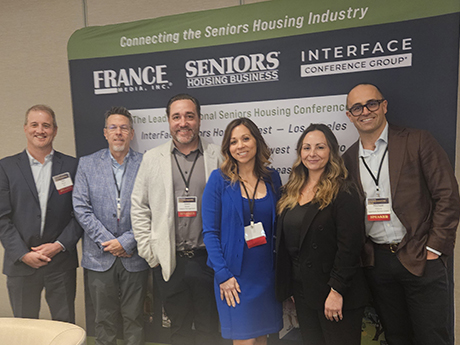
Dillard’s comments came during InterFace Seniors Housing West, an annual conference hosted by Seniors Housing Business that occurred Tuesday, Feb. 10 and Wednesday, Feb. 11 at the Omni Los Angeles hotel and drew 237 attendees. Dillard served as one of five panelists discussing seniors housing operations and marketing during a dedicated session moderated by Dan Baker, senior director of capital markets at JLL’s San Diego office.
Joining Baker and Dillard on stage were Melanie Mooney, vice president of operations at National Health Investors (NHI); Jason Reyes, principal at Calson Management; Michael Pittore, co-CEO of Agemark Senior Living; and Dan Williams, CEO of OneLife Senior Living.
Dillard’s anecdotal example of carefully selected verbiage reflects effort to deeply appreciate and engage with the senior living consumer, which became a central theme of the panel. Throughout the session, participants concurred that focusing on the people who comprise a seniors housing community — both the residents and employees — is integral to successful marketing and operations.
Devil Is in the Details
Echoing Dillard’s sentiment that granular elements matter, Williams shared that this dynamic is as true of the physical aspects of communities as it is of the more intangible marketing materials.
“When a consumer comes into the building, what are they going to notice and how are they going to feel?” posed Williams. “If you are missing benches and plants and details — I’m talking about trinkets in an armoire — these details matter.”
Because of this, Williams argued that an important aspect of marketing and operations is knowing when to invest capital expenditure (CapEx) into older communities. “What we see in our industry is a lack of CapEx put back into older buildings,” he argued. “When you neglect that, the communities are going to suffer.”
Personnel Are Paramount
However significant physical details may be, Pittore pointed out that it is personnel and interpersonal relationships that influence seniors housing environments the most. “A topic that has come up a lot in panels is about Class B and C properties versus Class A communities,” he interjected. “What we do in this industry is build relationships amongst the staff, with the residents and with their families, supporting one another — you can do that in the nicest, brand-new building or in a 30-year-old, Class C building.”
Reyes similarly emphasized the significance of staffing in cultivating quality in the senior living sector. “We have really been successful in being family owned and operated and being local to the communities — being able to hug our residents and staff and be present,” he shared of Calson Management. “Scaling makes it harder to do that, and one of the keys to success is having the right people who support your mission and can keep passing that along.”
Mooney shared that the NHI portfolio includes a property in Modesto, California, that proves the point the individuals populating the community are the element that carries the most weight. “This building has had the least amount of CapEx given to it, but the team is a long-tenured team, and they’re super close with the residents,” she divulged. “My motto is always that it doesn’t have to be new and shiny, but it has to be clean, and it has to be friendly and welcoming.”
Of course, the importance of the quality of the physical product and the importance of the personnel are not mutually exclusive, Reyes added. “All these things are important — the people, the physical plant, and if you have one without the other, you’re stranded.”
Creating Culture
Baker chimed in as well. “Culture eats strategy for breakfast,” he recited. The moderator then asked panelists how, given the established significance of staffing senior living companies and communities, their organizations cultivate winning cultures.
“You need to be intentional and deliberate about [culture] as a company,” Williams declared. “It’s leadership, it’s culture and it’s execution and discipline — if you can get those all working in a building, you have a recipe for success.”
Dillard shared that training is, unsurprisingly, critical. “We expect high performance out of our team members and employees,” she explained. “Are we developing high-level training to be able to match and mirror that? And what does our training look like to be able to support these team members?”
Pittore added that feedback is a meaningful part of ensuring good employee performance and culture. “If you don’t let someone know almost immediately where they’re falling down, you’re actually doing them a disservice,” he asserted. “It’s not being mean or overly punitive, it’s giving them an opportunity to get better.”
Panelists also agreed that careful selection of executive directors, who have an outsized influence on communities and other staff members, is essential.
“I can’t interview every caregiver, so we have to be able to trust that [executive directors] are going to hire the right caregivers,” explained Reyes.
“Your executive director can make or break you, really,” concluded Williams. “It’s critical that you train that leader and that they’re well versed in your culture as a company so that they can pass that down.”
Tech Talk
Baker also asked the panel participants to touch on the current role of technology in their operations. “How do you sift through the noise and focus on what’s actually going to help the company?” he questioned.
Pittore answered with some queries of his own that he argued help filter out new technology prospects. “Are we going to use it if we put this in there? Do people have the time and the understanding to use it?”
In a similar vein, Dillard shared that a selective approach to new technologies is best. “The amount of tech and AI that is still evolving is massive right now,” she said. “The biggest thing for our industry is being grateful that there’s so much out there but being disciplined. Create a team or role or time to vet these things to make sure that they are going to really, truly help.”
“Take a step back to identify what is the right one for me and for my company,” concurred Mooney. “I don’t want a vendor to give the operator something and say, ‘these are the five reports I can give you.’ I want the operator to be driving the demand and saying, ‘these are the reports I need.’”
One helpful use of technology, according to Dillard, is in the vetting and nurturing of leads for future residents. “From the time of inquiry to the time of move-in, that probably takes five to six months, and there is a lot of nurturing that has to happen during that time frame,” she observed. “Do we expect our sales director to do it all?”
Even as panelists recognized the necessity (and benefits) of staying abreast of technological advancements though, the conversation still turned back to the primacy of a hands-on, people-first approach.
“AI is not going to replace our employees,” asserted Reyes. “We have to be able to keep up with [technology], but we’re falling back on what is incredibly important, which is our staff at every level.”