
By Matt Valley
DALLAS — Favorable demographic shifts are providing a strong tailwind for the active adult sector, says Caroline Clapp, senior principal of research and analytics at the National Investment Center for Seniors Housing & Care (NIC).
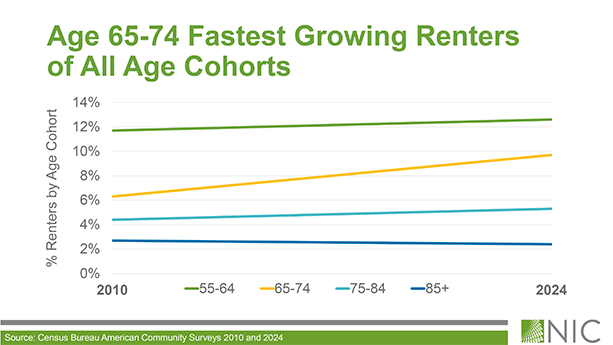
Individuals in the 65-to-74 age range represent the fastest-growing renter cohort in the United States, Clapp noted during her recent “Data Dive” presentation at InterFace Active Adult in Dallas. In 2010, this age group accounted for slightly more than 6 percent of all renters, according to the U.S. Census Bureau. By 2024, that figure had climbed to nearly 10 percent. This trend is significant because industry data shows the typical age for an incoming resident to an active adult community is between 70 and 72.
Editor’s note: InterFace Conference Group, a division of France Media Inc., produces networking and educational conferences for commercial real estate executives. To sign up for email announcements about specific events, visit www.interfaceconferencegroup.com/subscribe.
Another powerful catalyst for the active adult sector is the rise in the divorce rate among people age 50 and above, said Clapp. The divorce rate spiked in the late 2000s for this age group and has remained elevated, according to the Pew Research Center. More specifically, the number of divorces per 1,000 married women in the 50-and-over age cohort climbed from 3.9 in 1990 to 11 in 2008, before retreating slightly to 10.3 in 2023.

Ironically, during that same period, the divorce rate among individuals age 49 and below fell sharply from 28 per 1,000 married women in 2008 to 19.6 in 2023.
“Another way to look at this as potential demand for active adult rental communities is the rise in ‘gray divorce.’ Forty percent of divorces today have at least one person among the couple who is age 50 or older,” said Clapp, citing a statistic from the National Center for Family and Marriage Research at Bowling Green University.
Significance of Low Penetration Rate
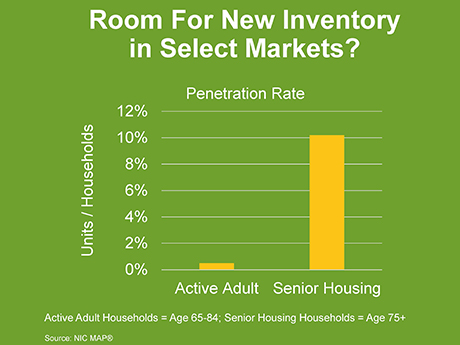
Real estate developers and investors closely study the market penetration rates when evaluating active adult projects. A low penetration rate implies there are opportunities for new development, while a high rate signals a competitive environment. The penetration rate nationally for active adult — defined as the total number of existing active adult units relative to the total number of age-qualified households (persons 65 to 84) — is 0.5 percent, according to NIC MAP. By comparison, the market penetration rate for seniors housing is 10 percent based on age-qualified households 75 and above (see chart above story).
The miniscule market penetration rate for active adult signifies a highly underserved, early-stage asset class, according to NIC. “Could this indicate opportunity [for development] in some select markets, assuming you’re doing your underwriting and your due diligence correctly?” asked Clapp
A Nascent Sector
In terms of the physical property count, the market is presently quite small, and the properties are relatively new. NIC MAP is currently tracking 875 properties totaling 129,000 units. The median number of units is 137 per property, and the median age of the assets is nine years. By comparison, the median age of traditional independent living communities is over 20 years, said Clapp. And the median age of a renter-occupied home in the United States is 45 years, the oldest on record, according to Harvard’s Joint Center for Housing Studies.
The Dallas-Fort Worth market accounts for 6.8 percent of the total U.S. active adult inventory, followed by New York at 5.1 percent and Los Angeles at 4 percent. Interestingly, Buffalo accounts for 2.6 percent of the nation’s total active adult inventory, ranking it 10th highest in that regard. Buffalo also boasts the highest market penetration rate nationally at 2.3 percent.
As of the first quarter of 2026, Dallas-Fort Worth was the largest active adult market in the country with over 8,800 units, followed by New York with 6,600 units and Los Angeles with 5,100 units.
The forecast calls for growth in this sector. The U.S. active adult community market size was estimated to be $661 billion in 2025 and is projected to reach $906.6 billion in 2033, according to Grand View Research.
Healthy Vital Signs
As of the first quarter of 2026, the average occupancy rate among stabilized active adult properties was 94 percent compared with 91 percent for all active adult communities. A property is considered stabilized if it meets either of the following criteria: (1) it has been open and operating for at least two years; (2) it is less than two years old but has already successfully achieved an occupancy rate of at least 95 percent at some point since its opening.
Clapp noted that the occupancy rates for both stabilized and unstabilized properties have softened a bit over the past few quarters but remain in line with the performance of independent living communities. Because active adult is a “choice-based product,” consumers who are feeling economic anxiety or residing in a challenging single-family home market for sellers may be inclined to sit on the sidelines a bit longer, she explained.
The annual retention rate among the mid-market, high-end and unbranded segments of active adult ranges between 64 and 67 percent, including involuntary and early move-outs, noted Clapp, citing data from Greystar. Meanwhile, the average annual turnover rate is about 35 percent.
Rent Range Varies by Market
The markets with the higher cost of living typically charge the higher monthly rents, Clapp pointed out, adding that the price range within any given market can be quite large. For example, monthly rents for active adult product in the Los Angeles market range from about $1,800 on the low end to approximately $5,900 on the high end, according to NIC MAP.
Monthly rents for active adult properties in the Dallas market range from $1,000 on the low end to about $4,500 on the high end. And in the Atlanta market, rents range from just over $1,000 on the low end to over $4,700 on the high end.
The very wide rent range in some markets might be an indication that developers are offering an assortment of product types in those markets, said Clapp.
Nationally, the median monthly rent for the active adult sector is less than $2,000, reports NIC MAP.