
By Matt Valley
ATLANTA — With the seniors housing occupancy rate riding high at 89.9 percent across the 31 NIC MAP primary markets as of the second quarter — but expenses also rising — what is the best way for operators to increase revenue?
“Elevate the services that you already offer,” advises Ahkira Beverly, vice president of sales and marketing at Senior Lifestyle. Doing so strengthens the brand, she insists. “It’s not about reinventing the wheel.”
As of June 1, Chicago-based Senior Lifestyle Corp. operated 10,086 units spread across 88 properties. The operator offers independent living, assisted living, memory care and skilled nursing.
Woody DeWeese, executive vice president of Parc Communities, a boutique developer and operator based in Atlanta whose portfolio includes independent living, assisted living and memory care options, echoes the sentiment expressed by Beverly.
“I think we can all agree that occupancy is at a pretty high point right now, and it looks like we’re going to be able to maintain that for some time. For us, it’s really just about fine-tuning the steps of service, dining and all the amenities in our communities, and measuring our residents’ satisfaction along with their families’,” says DeWeese.
“We’re using survey information to implement changes, allowing us to proactively meet residents’ changing needs, perspectives and expectations so that our team can continue to evolve and deliver those services,” adds DeWeese.
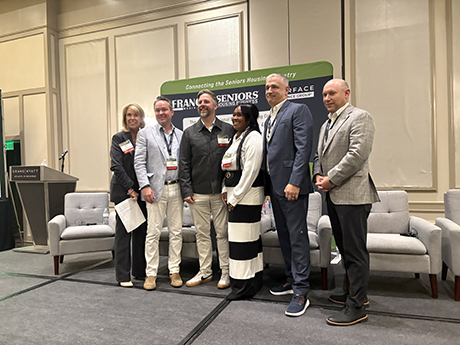
The comments from Beverly and DeWeese came Tuesday, Aug. 25, during the operations and marketing panel at the 13th annual InterFace Seniors Housing Conference. Jointly hosted by France Media’s InterFace Conference Group and Seniors Housing Business, the event brought together roughly 350 professionals at the Grand Hyatt Buckhead Atlanta.
Editor’s note: InterFace Conference Group, a division of France Media Inc., produces networking and educational conferences for commercial real estate executives. To sign up for email announcements about specific events, visit www.interfaceconferencegroup.com/subscribe.
Moderated by Mike McMillen, executive vice president of sales at SafelyYou, the panel also featured Tim Dunne, CEO of Claiborne Senior Living; Todd Filippone, president of SRI Management; and Kelley Skarp, senior vice president of sales and marketing for The Arbor Co.
Employee Retention Is Key
In addition to evaluating the services it provides and making adjustments as necessary, Tallahassee, Florida-based SRI Management is striving to achieve “consistency” across its portfolio of communities through employee retention.
“That’s one thing going into this year that we put a lot of focus on. Consistency is one of our core values,” said Filippone. “The most consistent presence every day is the employee who takes care of the residents because we are people taking care of people. So, we want to make sure we put a big effort into [maintaining] that consistency,” he added.
SRI Management’s portfolio comprises 6,109 units spread across 57 communities in 17 states as of June 1. The portfolio is concentrated in the Mid-Atlantic States and the Southeast.
Disciplined Approach Pays Off
McMillen, the session moderator, asked panelists if changes in the market — such as the steady rise in occupancy — have altered their go-to-market strategies in any way. (A GTM strategy is a step-by-step roadmap that a company uses to launch a new product or enter a new market.) “Is there a shift in selectivity around residents and acuity?” he asked.
“We haven’t been intentional about being more selective in the residents that we move into our communities,” responded Skarp of Arbor, which operates nearly 50 communities in 11 states, mostly in the Mid-Atlantic and Southeast regions. “It happened somewhat organically just by focusing and becoming more disciplined on what we’re doing day to day.”
Arbor studied all the costs, including marketing and advertising, associated with attracting new residents to communities. It was through that process that Arbor determined there can be substantial cost savings achieved by not relying on third-party referral sources to help fill buildings.
The operator soon discovered another benefit of cutting ties with referral agencies. “What we found is we’re also getting a less frail resident and a longer length of stay out of the resident that has come in,” said Skarp.
Third-party referral sources specialize in crisis management. When seniors get injured or have a sudden health decline, families turn to these referral sources for immediate placement.
Technology Plays Big Factor
In another example of Arbor’s disciplined approach, Skarp cited its decision this past year to use LeadGenie to operate a centralized, virtual sales hub that optimizes how resident leads are captured, qualified and nurtured. LeadGenie acts as an immediate response mechanism for incoming digital and phone inquiries.
“Today’s customers want what they want when they want it. They’re doing a lot of their shopping online. When they’rereaching out, they want to be able to speak to someone,” noted Skarp.
“We made a decision as a company that we did not want to lose any prospects that were reaching out to us.”
Fending Off Competitive Threats
McMillen pointed out that new development is ramping up in the Southeast. “What operational moats are you building to protect your communities?” he asked the panelists. “Is there still a durable advantage in service, culture and consistency? Are families starting to look at things like physical product, crown moldings and carpet? And which is harder to copy quickly?”
Dunne of Hattiesburg, Mississippi-based Claiborne Senior Living, a regional owner-operator with a portfolio of about 20 communities in five states, said it’s relatively easy to copy the floor plan, the building layout and the amenities. “The hard part is [replicating] what’s inside: leadership, employee experience, delivering on the brand promise. We can give you the recipe, but are you going to make it the same way?”
Atlanta-based Arbor is facing competition from new development cropping up in several markets in which it operates, says Skarp. “People are building pretty buildings, but there’s things that they can’t replicate.”
Arbor likes to showcase daily life at its communities through pictures and videos and even resident testimonials.
“Don’t get me wrong. Do I believe that a new shiny building coming into a market where my community is eight years old is going to be something that other people look at? Yes. I think they’re going to, but that’s a point of entry,” emphasized Skarp.
When prospective residents get to meet the staff of an established property that has a strong reputation and hear from the people that live there and see the established relationships, that experience can help tip the scales, said Skarp.
“It’s so much beyond the actual physical plant of the building that will help us stay focused on the resident experience, not just the brick and mortar.”