
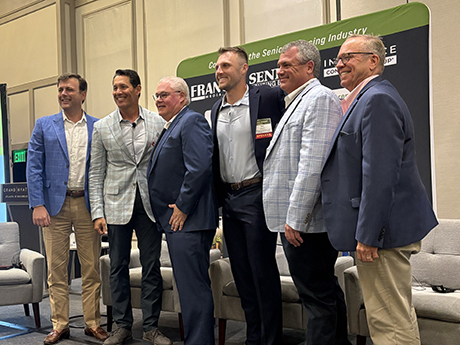
ATLANTA — Charlie Jennings, managing director and deal principal at Foundry Commercial, takes a strong stance on the next phase of seniors housing and the abundance of players interested in this undersupplied sector blessed with highly favorable demographics. “I hope the multifamily guys stay on the sidelines and stay in their lane.”
Jennings’ comment came during a panel titled “Rebounding Development Market: When Will Development Come All the Way Back?” at the 13th annual InterFace Seniors Housing conference, which recently took place at the Grand Hyatt Buckhead Atlanta. The event drew roughly 350 senior living professionals.
Most of the industry has been on the sidelines in recent years where seniors housing development is concerned. Exceptionally high construction costs and elevated interest rates have depressed the level of development activity to “record lows,” according to the National Investment Center for Seniors Housing & Care (NIC). As of the third quarter of this year, only 16,159 units were in development.
Although Dan Marinko, vice president of capital at Phoenix Senior Living and Partners Development Group, notes that development costs today are 30 to 40 percent higher than those of the pre-COVID era, the panel believes a construction boom fueled by staggering demand is imminent. Some developers are already availing themselves of select opportunities.
Jennings and Marinko were joined onstage by Kevin King, principal at BLDG Real Estate; David Coster, vice president of development with Retirement Living Associates; Tod Petty, chief investment officer of Mainstay; and moderator Will Childs, senior advisor at commercial real estate brokerage firm Senior Housing Services.
Best Real Estate Cycle Ever?
Seniors housing occupancy in the third quarter averaged 90.4 percent across the 31 primary markets tracked by NIC, up from 89.8 percent in the second quarter, reports NIC MAP.
That lofty figure reflects the heightened level of consumer demand for seniors housing product. “The statistics are all strong,” said Petty during the panel. “One out of every two people above the age of 85 is demented, driving them to needs-based senior living.”
Yet, NIC noted in its report that there is a paucity of new construction. By NIC MAP’s estimations, maintaining a steady occupancy rate of 90 percent nationally would require the senior living industry to produce 100,000 new units annually through the late 2030s. However, the current rate of development is yielding a mere 10,445 units each year.
These supply-demand dynamics have primed the senior living industry to enter its best-ever period, according to Jennings. “If the past is any real indicator of the future — which it tends to be in the cycles of the senior living space — I’m a firm believer that the cycle we’re entering now will be the best we ever see,” he asserted. “We’ll never see another [baby] boomer generation.”
New Capital Rushes In
These senior living tailwinds have caught the attention of investors outside the sector, panelists noted.
“Everybody that’s not already in senior living is either getting into it or thinking about getting into it,” observed Jennings. “It is the only real estate asset class that has seen double-digit returns over the last 12 months.”
According to the National Council of Real Estate Investment Fiduciaries, seniors housing posted a 10.6 percent total return in the NCREIF Property Index in 2025, outperforming all other NCREIF property types
“What we’ve found is a lot of new entrants wanting to get into the space,” echoed Coster. “We’ve spent a lot of time — some fruitful, some not so fruitful — educating them about the entire life cycle of seniors housing.”
Developers of master-planned communities are also taking note of the appeal of senior living units and beginning to incorporate seniors housing elements into their plans from the outset, Coster added.
These new players are in part responsible for driving up the acquisition cost of existing assets, Childs reflected.
“We triggered a point this year where you had to be above replacement cost to purchase an asset,” Jennings pointed out.
As the pricing of those existing assets rises and approximately 10,000 Americans turn 80 years old daily, the development prospects are compelling.
Demographics Alone Are Not Enough
Developers cannot execute projects based on the senior population alone, however. While the current demographics of the senior living sector are strong, they cannot ensure the success of any given seniors housing development, the panelists stressed.
“Don’t just assume that every single site in every market you like is going to work,” cautioned Marinko.
“To Dan’s point, just because the numbers and demographics are there does not mean that seniors will move in,” agreed Petty. “There are a lot of ‘ifs,’ ‘ands’ and ‘buts’ to check out to make sure that the development deal will work.”
Successful seniors housing development in today’s high-cost environment requires some ingenuity, particularly where middle-market product is concerned, Petty argued. “How can we bring that cost down in a way that translates to an affordable rent?” asked Petty before emphasizing that “it’s very difficult to do.”
Deliveries on the Horizon
Despite the challenging development environment, Mainstay is currently underway on projects at four different sites, with Petty estimating costs to be around $300,000 to $400,000 per unit.
Mainstay is not alone in moving forward on development projects.
“We were able to break ground on 91 cottage units last fall,” stated King of BLDG Real Estate. “We broke ground in May on 204 units of independent living, assisted living and memory care. We hope to break ground on the sister project in January.”
Meanwhile, Coster reported that Retirement Living Associates plans to break ground on a project this fall.
“Development is back selectively,” said Petty. “It’s back in emerging markets where residents need new product, and its back in secondary and tertiary markets where hospitals are locating. There are developers doing remodeling of hotels — conversions.”
In addition to the projects currently underway, there is a lot of behind-the-scenes development activity and planning across the sector, panelists pointed out. “A lot of developers are working through the entitlement and project-feasibility phase right now” said Marinko. “So, even if we’re not seeing those units under construction, a lot is happening. People are trying to move the ball forward.”
“Things are moving,” Coster reiterated. “That’s a good sign.”
While senior living developers are cautiously optimistic about the near-term prospects for the sector, panelists did not hesitate to outline the uncertainties and challenges moving forward.
“It will depend on the capital markets, but nonetheless people are working on stuff behind the scenes,” Marinko assured the audience. “I’m very optimistic about the space, but it’s going to take a village.”