
By John Nelson
ATLANTA — The first baby boomers are turning 80 this year, and research from NIC MAP, the data arm of the National Investment Center for Seniors Housing & Care (NIC), indicates that the 80-and-older population will grow by 1 million annually through the early 2030s. This swelling cohort is impacting demand for more senior living spaces.
However, construction of new seniors housing remains muted. Fewer than 24,000 units are under construction as of the end of the second quarter, which is the lowest level of supply in the development pipeline since 2012, according to NIC MAP’s analysis of the nation’s 99 primary and secondary markets.
Complicating matters further is that the existing inventory of seniors housing stock is aging, with some properties becoming obsolescent. Mark Heckman, senior living sector leader at Moseley, an interdisciplinary architectural firm based in Richmond, says that more than 50 percent of the existing seniors housing supply is at least 25 years old.
“Once you get to 25 years, you’re not just replacing the carpet,” says Heckman, whose firm has multiple offices in the Southeast and Mid-Atlantic. “You’re looking at systems and then accommodating the new desires of the next generation.”
Editor’s note: InterFace Conference Group, a division of France Media Inc., produces networking and educational conferences for commercial real estate executives. To sign up for email announcements about specific events, visit www.interfaceconferencegroup.com/subscribe.
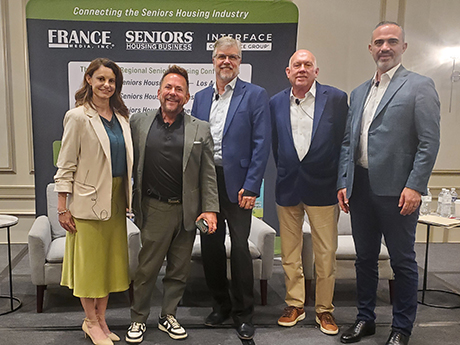
Heckman shared his insights during the architecture, design and construction panel at the 13th annual InterFace Seniors Housing conference on Tuesday, Aug. 25. Approximately 350 seniors housing professionals attended the event, which was held at the Grand Hyatt Buckhead Atlanta and hosted by France Media’s InterFace Conference Group and Seniors Housing Business. Rebecca Jourdan, client experience design manager at Direct Supply Aptura, moderated the panel.
Boomers Make it Their Own
While the discussion covered topics including the increasing adoption of artificial intelligence by architects and cost-cutting solutions by general contractors, the heart of the panel was the recognition of how baby boomers are fundamentally changing the look and feel of seniors housing.
“It’s all being driven by the boomer generation finally getting to our communities,” said Heckman. “We need to shift toward what the boomer preferences are.”
The panelists spent time discussing the importance of flexibility at the property level. David Fik, president and partner at Colorado-based Lantz- Boggio Architects, said it was important for seniors housing properties to have various spaces that foster “multi-activity” use.
“‘Multi-activity’ is a term I use for a space where you can invite all kinds of different… well different activities,” said Fik. “There may be a wall with a library that could have a bistro next to it, with a TV in the area and maybe some puzzle tables. Having a multi-activity room up front so that potential residents can see communication and socialization [among residents] is key.”
“Single-use spaces don’t exist anymore,” echoed Reid Bonner, founder and CEO of Senior By Design, a seniors housing interior design firm based in Dallas.
He added that boomers are not sitting idly by, waiting for spaces to be created for them — they’re making them for themselves.
“[Boomers] are grabbing what we’ve got and recreating it to be able to be flexible so that they can shine the way that they individually are,” said Bonner. “When we’re creating spaces, they need to be attractive and energetic, but they have to provide choices.”
The panelists also reflected on the importance of providing options for different personality types, with most of the speakers using their own parents to illustrate the point.
“My mother would be by the piano in the center of a patio area singing away, while my dad would be sitting in a far-off corner having an intimate conversation,” recalled Bonner. “The boomers who are coming in are looking for more. They’re looking for a space that is easier to adapt to and find themselves [within].”
Jourdan also said that the placemaking at seniors housing properties is important in order to create meaning for residents. She said one method is to facilitate connection between residents of different age ranges — from active adult to skilled nursing — and promote inter-generational relationships.
“There is a big difference between providing opportunities to play games and giving residents purpose,” said Jourdan. “The residents are living a full life with full experiences; we don’t all have to retire to leisure.”
Amenities In Focus
Jourdan did concede that the boomer generation is changing the paradigm because at this point, they are less focused on the care models provided and more interested in the hospitality-like amenities and accommodations they can enjoy.
“[Boomers] are demanding more,” said Jourdan. “They’re not asking how we’ll care for them but how can we help them live their best life.”
Some of the lifestyle-centric amenities being designed and incorporated into seniors housing communities look a lot like those found at student housing communities. For example, a growing number of residents are requesting gaming areas with golf simulators.
“Residents may have been very active with golf, or maybe it’s something they want to learn,” said Bonner. “Learning is such a key element for our spaces to be activated for classes.”
The panelists discussed how the baby boomer generation places a high priority on mental well-being. Heckman describes Moseley’s approach to senior living design as being more “fitness-forward.”
“Boomers want fitness-forward amenities that go beyond just a fitness room,” said Heckman. “It’s more about experiences than a fancy looking lobby. They want to be outside and connected to their community.”
The panelists also added that seniors housing communities are featuring more maker spaces. Bonner said that emphasis marks a shift from just being places where guests can create watercolor painting or pottery.
“Today it’s much more far-reaching,” said Bonner. “It’s also where people are meeting other people, and it’s all day long. The residents and their friends in the community are taking control of those spaces — they’re not waiting on a guest craft person to lead an event at 2 o’clock.”