
By Matt Valley
At least half of all seniors housing operating companies don’t make a nickel off the management of their buildings, says Jerry Frumm, vice chairman of Senior Lifestyle, a Chicago-based owner and operator. “At best, they’re breaking even on the management side. They’re making their money other ways.”
Editor’s note: InterFace Conference Group, a division of France Media Inc., produces networking and educational conferences for commercial real estate executives. To sign up for email announcements about specific events, visit www.interfaceconferencegroup.com/subscribe.
Some operators generate revenue through ancillary businesses or through ownership of the real estate on which the senior living communities sit, states Frumm. Another way for operators to make money is through the “promote” — the financial incentive that allows the deal sponsor or operating partner to receive a higher share of the profits once the investment exceeds a certain agreed upon target return.
Senior Lifestyle operates a portfolio of 93 communities highly concentrated in the Midwest and East Coast regions totaling 10,475 units. The company has an ownership position in just over 40 percent of the communities it operates.
While the consensus is that the operator is the key to success in senior living, “there’s a gap between how important everybody thinks we are and what people are willing to pay us,” says Frumm. The “people” he’s referring to are the owners and the senior living investment community in general.
“Late in my career — I’ve been at this for a while — I’ve decided that we need to talk about [this payment issue] a little bit more. In general, we haven’t really talked about it,” said Frumm, who’s toiled in the seniors housing industry for over 40 years.
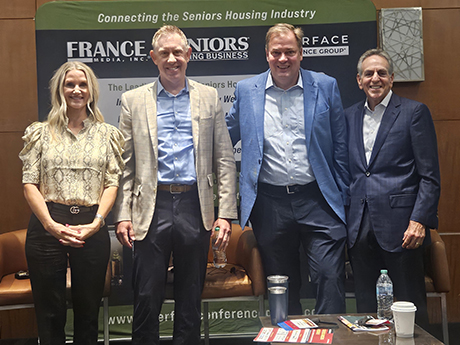
The pointed remarks by Frumm came June 24 during the “Power Panel” discussion at the 10th annual InterFace Seniors Housing Midwest at the Embassy Suites Magnificent Mile in Chicago. The conference, which featured seven panel discussions covering a variety of topics and included several networking opportunities, attracted approximately 200 industry professionals.
Joining Frumm on stage for the discussion were Dan Hermann, president and CEO of Chicago-based Ziegler; Joel Theisen, founder and CEO of Lifespark, headquartered in St. Louis Park, Minnesota; and session moderator Lauren Wilson, chief revenue officer of PalCare, a senior care technology company based in Milwaukee, Wisconsin.
How Are Operators Paid?
The compensation structure depends on the operational model. In fee-managed communities, operators earn a percentage-based fee on gross revenue and typically pair this with incentives fees such as bonuses for reaching occupancy or net income targets.
Many operators are not third-party managers, but rather business owners who lease the real estate or operate the business directly. In these models, they keep the net operating income (revenue minus all care, labor, and operational costs) rather than just a top-line percentage.
Heavy Demands on Operators
“This is a really complex industry. There are lots of moving pieces, and it’s getting more complex all the time,” emphasized Frumm, who then spoke directly to conference attendees. “The demands on the companies that are managing the communities that you’re financing, that you’re invested in, that you’re trying to sell products to are substantial.”
Operators take on plenty of “employee risk,” Frumm pointed out, referring to the operational, financial and legal liabilities stemming from workforce management, turnover and care delivery.
Frumm suggests that “for the health of the industry and for where everybody wants this to go, we need good, strong, healthy operators who have the capital to invest in the training, the systems, the programs that we need to be successful. And we can’t overlook that.”
Senior Lifestyle’s portfolio is 53 percent independent living, 31 percent assisted living, 12 percent memory care and 4 percent skilled nursing. The company operates seven rental continuing care retirement communities (CCRCs), which contain the skilled nursing units.
Diverse Revenue Stream
Originally launched as a private-pay home health and senior services provider in 2004, Lifespark today manages 51 senior livingcommunities, including 46 in Minnesota and five in Wisconsin. That number is expected to soon reach 60.
The majority of Lifespark’s portfolio is concentrated across independent living, assisted living and memory care communities. The operator also offers skilled nursing to a much lesser extent. The company generates nearly $100 million in annual gross sales.
“We don’t look at this [business] as just a real estate play or just as our only revenue source,” said Theisen. Lifespark operates its own dedicated palliative care and hospice programs. The company also provides specialized geriatric clinical pharmacy services through a joint-venture partnership with Consonus Pharmacy. In addition, Lifespark provides private-pay home care and private-duty nursing through its specialized branch, Lifespark Community Home Care.
“There are a lot of pieces that we put together over the past 20 years. Because of that, we don’t look at the client as just a private-pay kind of robot in our building. I mean, that’s not how people live. They live holistically, longitudinally. So, LifeSpark takes that longitudinal perspective. It’s not just healthcare fronted,” explained Theisen.
Furthermore, Theisen rejects the idea that seniors housing is a constant push-pull between hospitality and healthcare. “I think that’s bunk.”
The new entrants to seniors housing are older and exhibit more comorbidities and functional limitations than in the past, he noted.
“And the reason you take care of [their] health so much is to eliminate the exacerbations and problems people run into so they can live a more fulfilled life. Strength, purpose and belonging don’t come if you’re thinking about your knee, your hip, your diabetes, your cardiac situation.”
Lifespark operates its own internal geriatric medical program known as the Lifespark Medical Group. “This year we’re working toward having 85 percent of our residents in every building in our metro have [utilize] our primary care,” said Theisen.
In addition, Lifespark has partnered with Medicare Advantage plan providers to offer Institutional Special Needs Plans (I-SNPs) directly to residents. The company has also partnered with accountable care organizations (ACOs), such as those operating under Medicare Shared Savings Programs.
“We have all those payers. By doing that, we’re able to concentrate on making sure we keep the health problems [of the residents] out of the way so they can thrive. And with that, you can really double your revenue.”
View into the Not-For-Profit Universe
As a leader in municipal bond underwriting for not-for-profit senior living providers, Ziegler has extensive involvement with the financing of CCRCs. There are 1,900 CCRCs nationally, according to Hermann. Approximately 80 percent, or about 1,500 CCRCs, are non-profit. The remaining 400 are for-profit.
These communities offer a continuum of care, ranging from independent living to assisted living and skilled nursing. That continuum enables residents to remain in the same location as their medical or personal care needs change.
Because the InterFace conferences tend to attract industry professionals from the for-profit side of the business largely focused on independent living, assisted living and memory care, Hermann took the time to highlight some of the distinct features of CCRCs.
The average entry age for the new, modern product in CCRCs is about 80. By comparison, the average entry age at independent living and assisted living communities operated by for-profit providers is closer to 85.
The non-profit CCRCs are typically large in size. They tend to be situated on campuses ranging from 20 to 80 acres with 300 to 400 residents on average at each location. By comparison, the National Investment Center for Seniors Housing & Care says that standalone communities that offer independent living and assisted living average between 140 and 175 residents.
During the panel discussion, Hermann noted that Ziegler planned to take the financing of two separate CCRC expansions totaling $500 million to market the very next day. One CCRC expansion is in Connecticut and the other in Montana. (Taking the financing to market means formally presenting a large-scale bond issue to institutional investors to raise the millions of dollars needed to fund construction.)
These two large financings have made it across the finish line.
Last week, Ziegler closed on a $191.5 million bond financing through the Montana Facility Finance Authority on behalf of St. John’s Lutheran Ministries, doing business as St. John’s United. The borrower will use the bond financing to fund an expansion of the CCRC at the main St. John’s United campus in Billings, as well as the construction new independent living buildings at the WyndStone campus.
Ziegler served as the underwriter and arranger for the $191.5 million municipal bond financing through the Montana Facility Finance Authority on behalf of St. John’s Lutheran Ministries, doing business as St. John’s United.
St. John’s United, St. John’s Foundation and Missions United, collectively comprise the obligated group, which owns a multi-campus senior living system located in the Billings and Laurel markets of Montana. The system currently features five senior living communities totaling 201 independent living units, 140 assisted living units, 72 memory care units and 88 skilled nursing beds.
The nonprofit is undertaking a significant expansion project comprised of a new 12-story tower on the main St. John’s United campus in Billings. Known as Aeries, the tower will contain approximately 95 independent living units with various common areas and amenities. Additionally, St. John’s will add 19 new moderate income independent living apartments known as Chapel Court Living on the main St. John’s United campus and four new independent living four-plex buildings, including common areas, on the WyndStone campus.
On the heels of the deal in Montana, Ziegler closed a $304.1 million financing for the expansion of Fairview Vista Point in Groton, Connecticut, in one of the largest senior living tax-exempt bond transactions to date in the state.
The retirement community has evolved over the past 134 years from a single-structure retirement home to a licensed CCRC offering independent living apartments, cottage homes and a nursing home on approximately 70 acres.
The expansion, which will be constructed on approximately 20 of the undeveloped acres on the Fairview campus, will result in the addition of 193 new entrance-fee independent living units, 44 assisted living units and 28 memory support units.
A Selling Point for Seniors Housing
The United States faces a housing affordability and supply crisis. Experts estimate a nationwide shortage of anywhere from 3.8 million to 7.2 million homes. That’s why the 21st Century ROAD to Housing Act, which went into effect July 11, received such strong bipartisan support in Congress.
“You should be marketing that senior housing frees up market-rate units,” Hermann urged conference attendees. “I don’t feel like people market that enough to their local communities. Every person that moves into a new seniors housing location frees up market-rate housing for the general population to help solve the housing crisis. That’s how you can get zoning [for seniors housing]. People should be weaving that [narrative] into their local communities.”