

By Hayden Spiess
Baby boomers, who make up the much-anticipated “silver tsunami,” control an outsized portion of overall American wealth. This generation — born between 1946 and 1964 — comprises roughly one-fifth of the U.S. population yet holds more than 50 percent of U.S. household wealth, with over $85 trillion in assets, according to Federal Reserve data.Many of these seniors also have uniquely high standards and expect that their living arrangements will reflect these standards.
Richard Ackerman, founder and managing partner of Big Rock Partners, based in Beverly Hills, California, says that the expectations of the boomer generation mark a departure from previous generations. “They’ve lived a life a lot different from the cohort that came before, the World War II generation,” he explains.
“My father-in-law served in the Pacific, and he would have been fine with a cot. These seniors live in beautiful homes. They’re used to technology. They’re used to good food.”
Tim Gary, CEO of Atlanta-based Galerie Living, adds that the current generation of seniors is also more willing to spend money on a higher-end experience. “This generation has the expectation, and they have the wealth,” he says. “The generation prior to this maybe had the wealth but were not willing to spend it.”

Big Rock and Galerie cater to these discerning seniors, as do a number of other owners and operators that specialize in luxury senior living communities. Though there are distinct challenges associated with the still-evolving subsector, sources say that this is a well-
performing — and undersupplied — niche within the industry.
Heightened Hospitality
Given where today’s rental rates stand generally, some might argue that any senior living community could be considered a luxury. On the other hand, Mary Leary, CEO and president of Evanston, Illinois-based Mather, says that some consumers may see the concept of “luxury” as antithetical to senior living. “Moving to a community can be seen as needing to give things up, versus having options and choices,” she explains.
How then, is luxury seniors housing defined, outside of prices that are even more elevated than the norm?
“Luxury isn’t about chandeliers or marble for the sake of it,” says Tom Gaston, co-CEO of Westport, Connecticut-based Maplewood Senior Living. “It’s really about intentionality. Luxury shows up in beautiful spaces, yes, but also in service, programming, wellness and care that adapt to the individual.”
Patricia Will, founder and CEO of Houston-based Belmont Village Senior Living, says that one of the primary markers of a luxury community is an exceptional level of hospitality. Belmont Village develops, owns and operates a portfolio of luxury communities that currently comprises 35 properties located principally in coastal California, with additional communities in Chicagoland and coastal Florida.
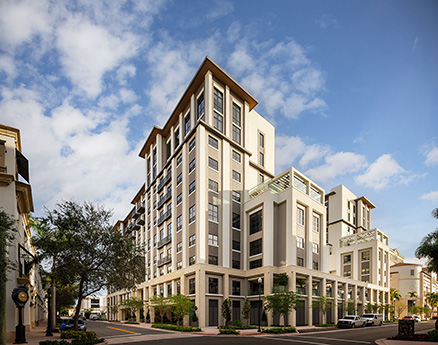
“Luxury in the seniors housing sector means not just great real estate in terrific locations, but also communities that offer very, very high-quality hospitality and high-quality resident engagement in all its forms,” asserts Will. “If you think luxury, you think Four Seasons or Ritz-Carlton, and you’re thinking of very high-quality food service and a very high quality at the point of service, as well as great real estate,” she continues. “Those things converging make the best in luxury seniors housing as well.”
Gary invokes those same luxury hotel brands when describing the nature of high-end seniors housing. “Luxury seniors housing takes into account a hospitality component along with the traditional medical model, with the hospitality model in the category of services that match the Four Seasons, the Ritz Carlton — the luxury hotel brands,” says Gary.
Galerie Living operates two distinct high-end brands, Village Park and Corso Residences. Corso is the more luxurious of the two.
Gary emphasizes that hospitality, when executed well, begins at the front door. “Are the services immediately there, like someone opening your car door, someone walking you in, someone greeting you?”Galerie also invests heavily in employee training. “We have a Galerie University,” shares Gary. “And even once you’ve trained people, they have to be continuously retrained.”
Emphasis on Amenities, Location
Another factor in setting apart luxury communities from other senior living product is amenities.
Amenities are an important draw for well-capitalized seniors and also represent a high cost for owners and operators. “It’s very costly because amenities are not revenue generating,” clarifies Ackerman. “Only 65 percent of our building generates revenue; 35 percent is amenity space.”
Jerry Frumm, vice chairman at Chicago-based Senior Lifestyle, recommends that owners and operators take cues from residents when designing amenities. “I’m a huge believer in resident-generated engagement,” he reveals.
Food and beverage offerings are especially significant in luxury seniors housing. “It used to be that we would have one main dining room,” says Frumm. “Today, people like different dining options. Sometimes, in really high-end communities, you have three to five different dining venues.”
“Any luxury brand has to offer multiple restaurants,” agrees Gary. At Galerie communities, restaurant offerings feature multiple locations and types of cuisine.
The recipe for a successful luxury senior living community begins well before residents move in, however. A high level of selectivity in choosing the location of developments is key.
Belmont invests a great deal of time in identifying and securing development sites. “We spend many, many, many years doing it,” says Will. In addition to time, optimal sites also require a fair amount of money and risk, she adds.
Ideal locations feature proximity to desirable neighborhoods as well as scenic views, Will explains. Such sites are difficult to obtain, creating greater exclusivity and limiting the level of supply within the luxury niche.
“Fewer developers will go after sites like that because of how long it takes, and there are very few sites available,” notes Will. “It’s not foolproof, but it creates a barrier to entry…we’re not going to see somebody on every corner.”
New Product
Frumm says that location also impacts the feasibility of development activity. “We’re very market-specific in this business,” he asserts, adding that the market in which a development opportunity is located can make or break the project. “We necessarily gravitate toward a higher-end market where I’ve got pricing power.”
This is especially true given the economic headwinds of today. “Inflation, supply chain disruption, tariffs and construction labor shortages continue to place pressure on development pro formas and timelines,” shares Leary.
“Developing at this level is complex and expensive,” Gaston points out. “You’re balancing residential design with safety, wellness and technology.”
Despite persistent challenges, Belmont Village is still executing new development projects. In recent years, Belmont opened a project in Los Gatos, California. Last year, Belmont opened a 177-unit community in San Ramon, California, and a high-rise property in La Jolla, and the company is underway on an additional project in San Diego County.
Belmont opened a community in South Florida in 2024 and is currently completing construction on a development in Aventura. Upon completion, Belmont Village Aventura will total 180,000 square feet with 153 independent living, assisted living and memory care apartments.
In addition to three existing communities in Florida, Big Rock Partners is currently developing a property in Delray Beach. The community will feature 174 independent living, 16 assisted living and 16 memory care units.
Big Rock is also underway on a 106-residence community with assisted and independent living in Kiawah Island, South Carolina, and a 255-unit independent living, assisted living and memory care development in Pennsylvania.
Galerie is underway on the second phase of Corso Atlanta and on a second, 500-bed Atlanta community. Galerie also plans to break ground on a 400-unit project in Chevy Chase, Maryland. Additionally, the company is in the entitlement phase for developments in Tysons Corner, Virginia, and Philadelphia. Monthly rental rates at Corso properties range from $12,000 to $20,000.
Gary stresses, though, that it is still difficult to make development projects pencil out, even with the prospect of higher rental rates once communities are open. “We still have the pressure of development cost.”
Selling Value
What makes communities more successful in the long run, says Gary, is being able to communicate the value to consumers. “You can make that a lot easier if you know how to sell the value of what you’re offering.”
Will concurs that communicating — and delivering — exceptional value is crucial. Starting rates at Belmont Village communities vary by market and range from $5,000 to $8,000 monthly, increasing from there by care level.
“Everybody has to deliver extraordinary value every day in order to get healthy rent increases,” emphasizes Will. “When it’s time to implement an increase, we have to count on the fact that our residents are very happy and appreciate the value we’re delivering.”
Happy residents also generate new leads and residents. “Our best source of referrals is from our own residents,” reports Will.
“Reputation, trust and word of mouth play an outsized role in occupancy,” concurs Gaston. “Residents and families at this level are very discerning,” he adds. “You have to clearly communicate why the experience is different and continue to deliver on that promise.”
Assisted living rates at Windsor at Celebration, a Big Rock Partners community in Kissimmee, Florida, begin at $6,480 per month. According to CareScout.com, this is roughly 30 percent higher than the median monthly costs for the area, which the source puts at $4,925 for assisted living units.

Because luxury senior living residents are more discerning, maintaining high standards once open is paramount. This, of course, comes with heightened costs. Much of this investment for Belmont lies in the hospitality elements of communities. “By and large, over 60 percent of our operating dollar is labor,” notes Will. “The more labor you have, the higher expenses are.”
Gary adds that luxury communities must invest in enhancing offerings each year to remain competitive and keep residents satisfied. “A good luxury brand like Corso will be improving and increasing our luxury standards almost 15 to 20 percent a year,” says Gary.
Luxury’s Strong Outlook
If residents are satisfied, it follows that they will also be more inclined to remain in place, bolstering occupancy at luxury properties.
Sources say that the luxury market benefits from the same broader fundamentals of high demand and low supply, plus the niche’s own tailwinds. “We’re undersupplied in seniors housing across the board, but our category is extremely undersupplied,” observes Gary. He asserts that luxury communities can see higher, more stable occupancy levels.
“You have a healthier resident, so your resident turnover is much lower,” he argues. Gary attributes this health and stability to the income and education level of luxury residents.
Research conducted by the Pew Research Center supports Gary’s anecdotal observations. According to Pew, a significant gap exists between the self-reported well-being of aging adults in higher and lower income tiers. Some 39 percent of seniors with lower incomes say that they are aging well. By comparison, 61 percent of seniors within the higher income tiers say that they are aging well.
According to Leary, Mather communities reflect these strong occupancy trends. “Existing communities are 98 to 100 percent occupied with strong waiting lists, and our newest community is nearing stabilized occupancy.”
Ackerman believes that not only is luxury seniors housing viable, but it also may be the most financially sustainable of all the types of senior living — at least in the current climate.
“Maybe you need a return, and you can’t get that return without the high rent,” he says, asserting that due to rising operating expenses, rents need to be elevated to achieve margins of 35 percent. Seniors housing properties that have been built within the past seven years have a much higher cost basis than their older counterparts, Ackerman shares. “To get the returns investors are expecting, given the higher risk of newer seniors housing assets, those communities need to serve a higher-income demographic.”
Beyond profits, Will says that delivering an outstanding luxury experience can be fulfilling in itself. “The biggest challenge is to know that every day you’ve got discerning customers, and you have to meet their expectations,” she reveals. “That’s also the biggest reward. We do well by doing good.”
— This article originally appeared in the December 2025-January 2026 issue of Seniors Housing Business magazine.