
By Jane Adler
Major urban areas tend to get most of the attention in the senior living industry. After all, these locations have large populations and submarkets with a sizable pipeline of income- and age-qualified older adults who potentially want or need independent living, assisted living or memory care.
But secondary and tertiary markets, occasionally overlooked, are generating solid investment returns and even outperforming big-city properties in many cases.
Smaller cities have less competition, say owners and operators. Existing senior living properties in secondary and tertiary markets refilled faster after the pandemic downturn, and occupancies at many communities are now approaching 95 percent.
Meanwhile, new construction in the industry is at a low point. NIC MAP, the industry’s data source, reports that the fourth quarter of 2025 saw the lowest number of units under construction in the last 10 years across all markets.
Most projects that are underway are located in major metros. Developers have relatively few projects under construction in outlying areas.
Investors and operators say they can find pockets of value in secondary and tertiary markets. Rents are rising in smaller cities, though there are concerns about how much increases can be pushed while serving consumers potentially less affluent than their big-city counterparts.
Operating expenses in secondary and tertiary markets tend to be held somewhat in check because of the overall lower cost of living and wages. Also, operators don’t face the regulatory burdens present in some big cities.
Currently, cap rates are generally higher — 8 to 9 percent — for small town properties compared with 6 to 6.5 percent for those assets in large locales.
Small markets have more perceived risk. Concerns revolve around the possibility that it may be difficult to exit a smaller market investment. Also, the loss of a handful of residents in a building with a relatively low number of units can have a big impact on performance.
Labor is a two-sided coin. The labor pool is shallower than in major metros, though the workers in small markets tend to be more loyal, operators say.
Investors who do get comfortable with smaller markets can find solid returns.
“We see strength in smaller markets for the foreseeable future,” says Dennis Murphy, chief investment officer at Fort Wayne, Indiana-based Priority Life Care, which operates 63 properties, about half of which are in secondary or tertiary markets. Murphy is based in the firm’s Boston office.
Categorizing Small Markets
The definition of a primary versus secondary market varies by source. One senior living operator says primary markets line up with National Football League cities. This article uses the definitions outlined by NIC MAP based in Raleigh, North Carolina.
NIC MAP classifies the primary markets as the top 31 core-based statistical areas defined by the U.S Office of Management and Budget. NIC MAP also tracks 68 secondary markets and 41 additional markets. A recent expansion by the data analytics firm brings total coverage to 214 markets, with another large expansion of 75 markets scheduled for early this year.
Examples of primary markets are New York City and Dallas. Secondary markets include places like El Paso, Texas, and Richmond, Virginia. Tertiary markets include locations such as Flint, Michigan, and Port St. Lucie, Florida.
“NIC MAP’s market data is projected to cover a high-90s percentage of the country over the next few quarters.” says Arick Morton, CEO at NIC MAP. He adds that secondary and tertiary markets have delivered higher occupancy rates than the primary markets over the last five years (see related sidebar).
Some investors and operators prefer secondary and tertiary markets.
“There’s value to be had there,” says Kevin Pascoe, chief investment officer at National Health Investors (NYSE: NHI), a real estate investment trust based in Murfreesboro, Tennessee. Most of NHI’s senior living portfolio is located in secondary markets adjacent to NIC MAP primary markets. “We find pockets of value in these secondary markets.”
In December 2025, NHI announced the acquisition of a 107-unit assisted living and memory care community for $52.1 million in Jamison, Pennsylvania, 35 miles from Philadelphia. The REIT also acquired a 56-unit assisted living and memory care community for $7 million in Anniston, Alabama, about 60 miles from Birmingham.
Smaller markets have a different profile than big markets, according to Pascoe. That affects how potential investment properties are evaluated and underwritten. “We look at the quality of the real estate, the operator and what type of financial structure makes the most sense,” he says.
Ideally, NHI prefers a building less than 10 years old and no more than 15 years old. The age and income market analysis must demonstrate a growing senior population that will exceed the existing number of senior housing units, says Pascoe.
The Jamison property is a fitting example of the type of secondary market investment sought by NHI. The eight-year-old property was sold as a single asset.
Occupancy was at 92 percent at closing. The operator is Priority Life Care, which has the opportunity to evolve its relationship into a partnership with NHI.
“We think we can get some good returns,” says Pascoe. He explains that the community in Jamison is initially being leased at an 8 percent yield. “That’s about as good or better than where we see many transactions close in today’s market,” says Pascoe.
NHI has the right to convert the property to a RIDEA structure if certain conditions are met. “We expect our operating partner (PLC) to grow NOI over time and outpace the growth of a traditional lease. Generally, we are looking at deals that can approach double-digit growth over the first few years of the investment,” notes Pascoe.
Labor Issues
Clarion Partners, a real estate investment fund based in New York City, recently made its first seniors housing purchase in Mechanicsville, Virginia, population 42,000. The town is located about 15 minutes from Richmond (a NIC MAP secondary market). The community, Sancerre at Atlee Station, opened in 2023.
“We use certain key metrics to support our investment,” says Julie Robinson, managing director and head of healthcare at Clarion. “Locations must have appropriate population density, a growing senior and/or adult child population, no directly competitive new supply underway and significant household net worth.”
Another big factor is the labor market. Clarion favors micro markets with relatively high home values surrounded by broader areas with more affordable housing for the workforce. “We look at vocational workforce population growth and wage growth in the broader market as well,” says Robinson.
Robinson notes that seniors housing communities with a strong culture of shared values and clear expectations create more loyal employees. “There’s more stickiness with workers when they enjoy showing up every day.”
Stellar Senior Living conducts a deep labor analysis during site selection. The company owns and operates 41 communities in the West. About one-third of the properties are in secondary or tertiary markets.
Locations include Grand Junction, Colorado; Spokane, Washington; and Albuquerque, New Mexico, among others. Stellar opened two new properties in the last 18 months — one in Broomfield, Colorado, north of Denver; and one in Spokane, Washington. Stellar is underway with a new project in Boise, Idaho.
“These markets perform just as well — if not better — than larger markets,” says Adam Benton, senior vice president at Stellar in Midvale, Utah
“You can find phenomenal employees in these markets to help care for seniors,” says Benton. It’s easier to find quality workers in smaller towns than in the big cities where the company operates such as Seattle, he explains. Urban workers have a lot of options for employment. Whereas in smaller municipalities, the local senior living community is considered a fine place to work with opportunities for advancement into leadership roles.
“It’s a fight for talent all the way around,” says Phil Barklow, president at Experience Senior Living in Denver, Colorado. The company operates 15 communities and has seven under construction with partner NexCore Group. Barklow adds that it can be easier to recruit top talent in small markets that are growing and gaining appeal as places to live.
Strong Margins
Buildings in secondary and tertiary market typically contain anywhere from 50 to 150 units. “These are smallish buildings,” says Murphy at Priority Life Care.
The company targets properties with a minimum of 80 units. “Any smaller than that, and the buildings are inefficient from a staffing perspective,” he says.
Priority Life Care’s small-market properties have maintained high occupancies. “These buildings have strong margins,” he says. “They’re good performers for us.” He adds that overall portfolio occupancy has grown about 1 percent per month over the last seven months. “We expect that trend to continue.”
Kelly Sheehy, founder and managing partner of Arcole, a healthcare real estate investment platform, prefers secondary markets with enough affluence for consumers to afford private-pay
senior living, but not so much wealth that they’re able to bring 24-hour care into their homes. A former executive at Artemis Real Estate Partners, Sheehy launched Atlanta-based Arcole in December 2025 with capital partner Town Lane of New York City.
With the cost of care up 50 percent since the pre-Covid period, Sheehy says affordability is a challenge.
“In some smaller markets, people can’t pay for the labor component. This business is taking care of people, and you have to pay for that.”
Arcole has six properties in its portfolio and expects to add another five to six this year. Targets include smaller markets as well as outer-ring suburbs in primary markets.
An example is The Overlook at Suwanee Town Center, located about 33 miles northeast of Atlanta. Arcole and Town Lane acquired the 175-unit property in December 2025. Atlas Senior Living is the operator.
Residents tend to have a slightly shorter length of stay in smaller markets, according to Murphy.
Consumers tend to wait as long as possible before moving into senior living, and they have a higher acuity than seniors in big markets, he explains.
“We do our best to prolong their length of stay by making sure they are in units they can afford,” says Murphy.
Rents are lower in smaller markets than in primary markets. A one-bedroom unit in a Class A assisted living property in a major metro will cost $8,000 to $10,000 a month. The same package will cost about $5,000 to $6,000 in a secondary market.
Owners and operators have been able to raise rents in smaller markets. But properties in primary markets will have greater ability to push rents higher in the years ahead, NHI’s Pascoe believes. “Can you charge 5 to 6 percent more annually in small markets?” he asks.
Income growth may not keep up with big rent increases. “Be realistic,” he adds.
Consumers in smaller markets are definitely more sensitive to high rents, according to Michael Levine, senior managing director overseeing the active adult portfolio at Greystar, headquartered in Charleston, South Carolina.
The company owns 160 active adult properties in 32 states, with 10 new communities underway. Greystar focuses mostly on big markets but is growing its portfolio in secondary markets.
“The goal is to capture the same type of resident while avoiding the cost and friction we see in some urban markets,” says Levine.
He pinpoints lower land and construction costs and fewer hurdles with municipal reviews. “It’s a compelling opportunity for us,” says Levine.
Arcole’s Sheehy agrees. “I get nervous with larger primary markets and regulatory concerns [ranging] from minimum wage laws to staffing regulations. We seek to avoid markets with unnecessary or unpredictable regulatory exposure,” says Sheehy. “I want to focus on the markets I want to be in.”
A red flag in small markets is the possibility of new construction. A big jump in the number of available units can quickly throw occupancies into a tailspin.
“Smaller towns are more susceptible to competition,” says Sheehy. “There’s more land and it’s cheaper to build there. Existing communities might not have the capacity to withstand the competition.”
New competition is not a near-term concern because of the high cost of construction. “But competition is something that does impact value in a smaller market,” he says.
“Even though a small market property might perform well, there’s a perceived risk if a new building opens in the market,” explains Stellar’s Benton. “It doesn’t take much to rock the boat.”
Resale is another factor. Large metros have a deep pool of potential buyers when it comes time to sell a property, according to Benton.
He adds that many investors prefer big markets for one of two reasons: their overall depth and a much larger pool of prospective residents.
For now, limited new supply, solid occupancies and manageable operating expenses are proving that smaller markets can deliver big results.
Development Drought Benefits Markets like Racine, Wisconsin
The surprising strength of seniors housing in secondary and tertiary markets nationally compared with the primary markets has captured investors’ attention.
The average occupancy rate across the 31 primary markets tracked by NIC MAP was 89.1 percent in the fourth quarter of 2025. For secondary markets, the average occupancy was even higher at 90 percent. Tertiary markets performed the best of all with an average occupancy of 90.4 percent.
Examples of markets with occupancies above 95 percent include, Norwich, Connecticut; Lebanon, Pennsylvania; and Janesville, Wisconsin.
Markets with occupancy rates from 93 to 95 percent, typically considered full stabilization, include Racine, Wisconsin; Reading, Pennsylvania, Burlington, North Carolina; Sebring, Florida; and Spartanburg, South Carolina.
Small markets generate higher rent growth, too. Annual rent growth was 4.4 percent in the primary markets, compared with 4.7 percent and 4.9 percent in the secondary and tertiary markets, respectively.
“Despite being smaller and often viewed as less supply-rich, these markets actually report higher occupancy rates and greater annual rent growth than the major metros,” says Arick Morton, CEO at NIC MAP.

The differences can mostly be explained by far less new development in smaller markets over the last decade, according to Morton.
“Although construction is subdued overall, what little development is occurring is still weighted toward the major metros,” he says. Smaller markets have stronger demand fundamentals and comparatively little to no new supply coming online.
Primary markets recorded a construction-to-inventory ratio of 2.3 percent in the fourth quarter of 2025, according to NIC MAP, compared with 2.2 percent in secondary markets and 1.6 percent in tertiary markets.
Some secondary markets have more than double the average level of construction. These markets — which typically have strong occupancies (above 90 percent) — include Virginia Beach, Virginia; Jacksonville, Florida; Spokane, Washington; Raleigh, North Carolina; and The Villages, Florida.
Examples of markets with no new construction include Baton Rouge, Louisiana; Birmingham, Alabama; Buffalo, New York; Syracuse, New York; and Norwich, Connecticut.
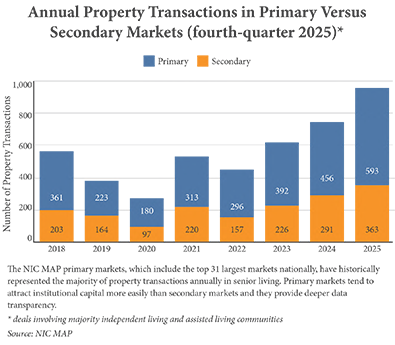
The primary markets represent a majority of property transactions and higher prices. The price per unit in secondary markets in the fourth quarter of 2025 was $144,000, about 24 percent lower than the $189,000 per unit in primary markets.
“The aging wave is here and the opportunity is pretty widespread,” says Morton. “It’s a universal trend. Baby boomers live everywhere, which creates opportunities for the industry to serve them.”
— Jane Adler
— This article originally appeared in the February–March 2026 issue of Seniors Housing Business magazine.