
Navigating complex, siloed operating systems to update residents’ medical data is a common source of frustration for managers of seniors housing portfolios. At Leisure Care, one of the nation’s largest privately held retirement and assisted living companies, this particular pain point was consuming much of the clinical staff’s working hours and detracting from their available time to care for residents.
Diane Umayam, Leisure Care’s vice president of Health Services at the Seattle, Washington-based organization, noted that the electronic health record (EHR) software her teams were using often required them to reenter a resident’s identifiers and other information to satisfy a disparate assortment of record sets and reporting formats.
“The system could be cumbersome because it was not web-based,” she says. “It took multiple clicks and a good deal of time to navigate.”
Determined to relieve the documentation burden on staff and achieve a more detailed view of activities and costs, Leisure Care set out to find an EHR platform better suited to its size and needs. The new system would be web-based, linking Health Services teams across 38 seniors housing communities coast to coast. And it would need to offer efficient, streamlined navigation and data collection to help those employees spend less time at their keyboards and more time looking after residents’ health.
A More Integrated Approach to Clinical and Operational Data
After evaluating several options, Leisure Care chose ALIS by Medtelligent to help manage its health records. More than an EHR, ALIS (pronounced “Alice” and standing for Assisted Living’s Intelligent Software) is a web-based platform designed to solve the everyday challenges of staff scheduling, care tracking, survey readiness, compliance and reporting that senior living communities face.
With the rollout still underway, the transition is already producing tangible improvement in workflows and morale.
“It’s been a large undertaking, but we’ve found ALIS to be really easy to work with. The fact that the software is so intuitive and comprehensive was one of the reasons that we switched to it,” Umayam says. “It’s easy to navigate and has been very welcome where we’ve introduced it; at those communities where we haven’t yet rolled out ALIS, they are excited to be getting it.”
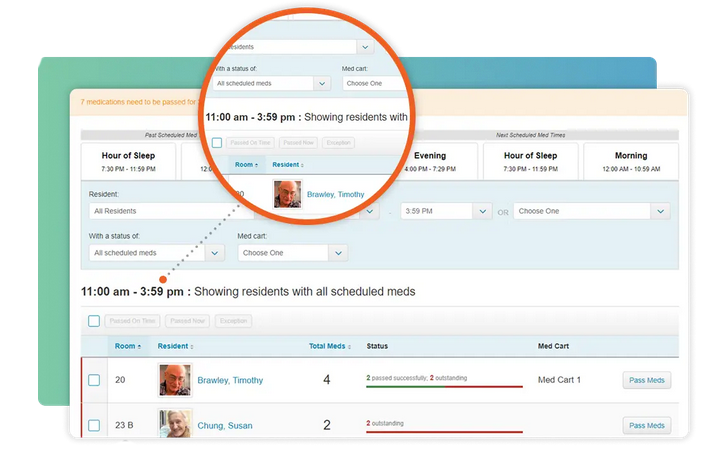
One of ALIS’s standout features is data fields that automatically populate names, addresses and similar patient details across linked records, greatly reducing the effort required to fill out medication logs, incident reports and other forms.
“Because information is entered in one place and populates to others, ALIS does a great job of eliminating duplicate entries, and teams aren’t feeling like they have to do everything two or three or four times,” Umayam says. “We’re finding that saves an immense amount of time and there’s less frustration.”
ALIS is built for speed, with intuitive dashboards and tools to expedite common tasks. Its records request tool, for example, can produce in seconds a report that may take a week to assemble using conventional applications dedicated to narrowly defined record types.
Health Services teams have quickly learned how to use the platform’s powerful reporting tools to work smarter, alerting them to investigate or intervene when a resident’s subtle behavioral changes suggest elevated risk for a fall or illness. For administrators, tracking service delivery helps to set more accurate, cost-based pricing.
“The reporting tools are incredible,” Umayam says. “We take a close look at missed meds, missed services and falls, because those are really important to us. We’re using ALIS to align our level of care with our billing practices, so that we make sure we are capturing that cost of care appropriately.”
Ongoing Streamlining
For most portfolios, ALIS configures the system on a new user’s servers in a matter of days. Teams participate in a series of trainings and receive ongoing technical support. ALIS supplements that training with regularly scheduled business review sessions, which help the provider keep each client’s configuration tuned to evolving needs.

CEO, ALIS
“We view ourselves as an extension of our client’s business,” ALIS CEO John Shafaee says, explaining the provider’s partnership approach to product development and support. “We ask what they are doing today and then configure the tool to fit.”
In addition to medical records management, ALIS offers modules for customer relationship management, business intelligence, property operations and financials, as well as Ask ALIS, an AI tool for seniors housing operators. ALIS can integrate a client’s existing software for those functions, and the software partners with more than 170 vendors to provide operators greater interoperability between their technology systems.
Leisure Care began its software transformation to improve its clinical records handling, and, for now, the company is using ALIS solely for EHR management. That said, the platform’s robust integration capabilities were a deciding factor in Leisure Care’s selection, Umayam says.
“From move-in to move-out, there are some very seamless documentation opportunities there,” Umayam says, referring to ALIS’s compatibility with a wide range of seniors housing applications and activities. “We’ve decided to explore those integrations after the ALIS rollout, and we are excited about all the potential that’s there.”
— By Matt Hudgins. This article was written in conjunction with ALIS, a content partner of Seniors Housing Business.
For information on becoming a Seniors Housing Business content partner, contact us.