
By Beth Mattson-Teig
Fueled by booming demand and sharper market insights, the active adult sector is hitting its stride and redefining what senior living can be for a new generation of residents.
Active adult is still in the early innings with plenty of runway for growth as the sector continues to mature and evolve. A big part of that evolution relies on continuing to collect data and using lessons learned to adjust development strategies and operating models.
“We don’t have one-size-fits-all for every market. One thing we’ve learned over time is that we should have different brands, different price points and different service levels,” says Zach Crowe, managing director of U.S. real estate at Washington, D.C.-based Carlyle, one of the largest investors in the active adult sector. Over the past 13 years, Carlyle has invested in more than 100 active adult properties and development projects.
The market is expanding in both depth and breadth due to what many view as an overwhelming supply-demand imbalance. Active adult is a fraction of the size of the multifamily market. For example, the National Investment Center for Seniors Housing & Care (NIC) MAP is tracking an active adult universe that spans 841 properties and 124,938 units across the U.S. — half of which have been built in the last decade.
Similar to the different brands and price points in the hotel market, there are different service levels and pockets of demand within active adult, adds Crowe. “It’s just important to understand the consumer in that specific submarket — the demographics and psychographics — and having the right operator,” he says.
Despite opportunities, active adult also faces barriers that include finding the right locations, high construction costs and somewhat of a “fuzzy” definition.
The properties, and lifestyle that they offer seniors, are by no means cookie-cutter. Active adult bridges that key gap between conventional multifamily and independent living. However, properties have different models when it comes to design, operations, programming and pricing.
In 2022, NIC released its definition of active adult: age-eligible, market-rate multifamily rental properties that are lifestyle focused, with general operations that do not provide meals.
“The product is still being defined, and the market data is thin,” acknowledges Karla Carlson, executive vice president of Amira Senior Living, a division of Minneapolis-based United Properties. “That does make it a little bit challenging from an investor perspective to understand the investment thesis, including what it is that differentiates active adult from market rate and differentiates it from traditional seniors,” she adds.
Growing Track Record
What investors do understand, however, is the strong performance and outlook for steady demand given the wave of aging boomers. According to NIC MAP, active adult is outperforming other sectors within senior living. Stabilized occupancy overall is averaging 92 percent, with stabilized occupancy among newer active adult properties averaging nearly 96 percent.
“Although the product has proven itself and done really well over the last decade, the sector is still in its infancy. The next decade is probably the most crucial for this product to really take off and further expand,” says Michael Levine, a senior managing director at Greystar Property Management Services based in the New York City area where he oversees operations for the active adult platform.
For the broader active adult industry, it will be important to put a heavy focus on operations and explain the “why” of the product in terms of its value proposition, he adds.
Active adult represents the fastest-growing portfolio for Greystar on a percentage basis. The company’s active adult portfolio now spans more than 160 properties in 32 states. About 70 percent of its portfolio is third-party management, but the firm also is a developer of active adult properties.
The sector’s strong performance is attracting both developers and investors. For example, Minneapolis-based United Properties is a long-time seniors housing developer that shifted its focus to active adult several years ago.
“One of the big reasons that we pivoted into active adult is it’s not as heavy on the labor and operations side,” says Carlson. It’s a different risk profile, and properties can charge a rent premium because of the operations and programming.
The company currently has three fully stabilized active adult properties in the Minneapolis metro, two projects in lease-up and two additional projects underway — one in Minnesota and one in Denver.
“The lease-up performance that we’ve seen on the properties that we’ve delivered has really outperformed our underwritten expectations, and it has proven to be a really durable cash flow for us,” says Carlson.
United Properties has been delivering communities that are between 60 and 70 percent pre-leased at completion. Starting out with strong occupancy not only helps with cash flow, but it also really sets the tone for a vibrant community, adds Carlson.
Different Models Emerge
The evolution of the active adult industry is resulting in differentiated strategies and product. One of the big shifts over the past decade has been the emergence of highly amenitized Class-A properties.
“The focus is on amenity-rich, purpose-built active adult living that’s designed around prioritizing lifestyle, with a resident focused operational model similar to multifamily rather than assisted living,” says Michael DiGiacamo, COO of The United Group of Companies Inc. “That’s where we see the gap in value compared to product built 15 years ago.”
United Group has been in the active adult space for 20-plus years, developing more than 4,000 units and is currently managing over 6,000 units within the sector. The company has shifted its development focus to building Class-A active adult properties over the past decade.
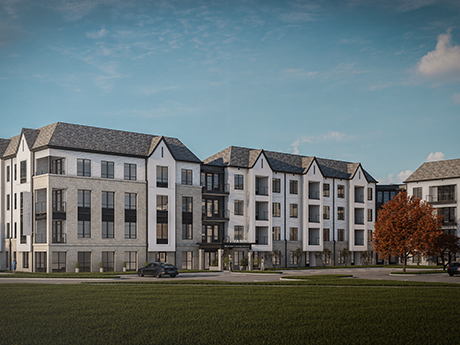
The sector also is seeing a rise of branded lifestyle communities. For example, Indianapolis-based Avenue Development is building Vive Bene-branded active adult properties. Viva Bene, which means “live well” in Italian, combines the preventive nature of primary care services with the proven benefits of an active and social community to promote wellness and longevity.
The data shows that most seniors age 70 and above are already managing one or two chronic conditions. So, the goal for Avenue Development was to bring in care partners to help residents manage their chronic conditions and help prevent further health issues. For example, residents are encouraged to exercise to prevent osteoporosis.
“It’s beneficial to help seniors stay in a social community longer, as well as being a lower cost option in the continuum of seniors care for residents and their families,” says Laurie Schultz, CCIM, principal and co-founder of Avenue Development.
The boutique firm’s first property opened in early 2025 in St. Louis, and the 161-unit community was 73 percent leased after the first year. Avenue Development also broke ground recently on a new 170-unit active adult project in Carmel, Indiana, that will open in early 2028.
“Active adult has a tremendous opportunity to bring people out of their homes to live in a community setting, but right now we are battling a difficult environment where seniors are wanting to stay in place,” says Schultz.
So, the focus for active adult needs to be creating opportunities for socialization and activities, as well as offering other value-added services that attract residents, she adds.
Tailoring Properties to Local Markets
Early on, many of the projects being built were “afterthoughts,” notes Crowe. For example, if a developer couldn’t get entitlement for a multifamily project, it would change direction to a 55-plus property.
Today’s purpose-built product involves more of an intentional approach whereby developers are digging into the demographics and psychographics of a market to understand who their target customer is to guide site selection, price point, design, amenities and the lifestyle programming.
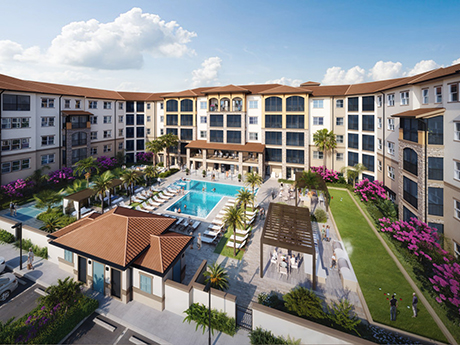
Developers are thinking outside the box to design projects that fit what their customer is looking for in an active adult property. And they also recognize that tailoring a property to fit what local communities want is key to success. “We’re seeing a lot more collaboration and customization in new development versus just putting up boxes and letting people move into them,” says DiGiacamo.
For example, United Group is adding six penthouse units to its new Terracotta Terrace property under construction in Casselberry, Florida. In contrast, its latest development in Bloomfield, Connecticut — the Arbella at Blue Hills — will feature apartments and garden-style townhomes.
“The beauty of any real estate development is the creativity you can put behind it and the impact it has on the communities you build in. But ultimately, these deals have to make sense and make money as well,” says DiGiacamo. That involves having the developer, contractor, architect, property management team and lender all working together, he emphasizes.
New Player Emerges
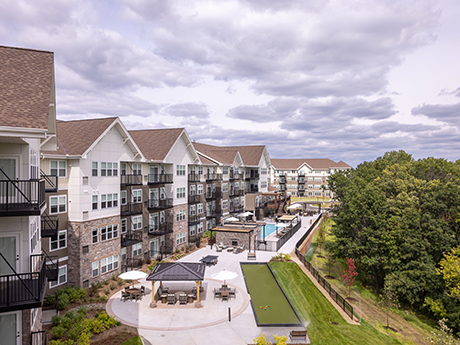
One longtime developer new to the active adult space is CR Endeavors, which recently completed Arise Knox Square in Hoover, Alabama, a south suburb of Birmingham. The 163-unit upscale rental community is located within Trace Crossings, a mixed-use neighborhood in the heart of Hoover that supports intergenerational living and walkability thanks to nearby single-family homes, local restaurants as well as medical, office and retail space.
Opened in spring 2025, Arise Knox Square is located directly across the street from the 10,800-seat Hoover Met Stadium, which annually hosts the SEC Baseball Tournament. Village at Knox Square is adjacent to the property and features various restaurants, retailers and services like a Pilates studio.
Residents of Arise Knox Square enjoy a blend of resort-style amenities and programming. The property features a lifestyle concierge who curates monthly events based on input from the residents.
“We develop projects with the belief that prospective residents want to live in an area that provides holistic wellness and social engagement that doesn’t end when they leave the comfort of their new home,” says Nikki Jo Olsen, vice president of sales and operations for Arise Elevated Living, a subsidiary of Birmingham-based CR Endeavors. Arise manages the developer’s portfolio of active adult properties.
“We like to focus on intergenerational living and being a part of a larger development that includes walkability to retail, restaurants, medical services and offices that foster both independence and neighborly connections,” emphasizes Olsen.
Amenities at Arise Knox Square include a clubhouse, coffee bar, fitness studio that opens to a yoga lawn, a resort-style outdoor pool, cabana, bocce court and fire pits.
“We also have a club room that features a fireplace, a bar and a beautiful porch. Our demonstration kitchen with an expansive communal dining area has quickly become a multi-purpose space for our residents from hosting cook-offs and happy hours to mystery-theme dinners. Each of our spaces are uniquely designed for programming and to create both programable and spontaneous connections for those we serve,” says Olsen.
One-bedroom units (670 to 1,109 square feet) at Arise Knox Square start at $1,599; two-bedroom residences (1,250 to 1,579 square feet) start at $2,723; and one- and two-bedroom cottages (760 to 1,220 square feet) start at $3,200.
The average age of a resident at Arise Knox Square is about 70 to 72. Many residents have selected the property to be near their adult children, notes Olsen. The active adult community has largely attracted seniors from a five- to 10-mile radius, but some residents have moved from the Carolinas and Florida. One resident even moved all the way from the State of Washington to Hoover.
Arise Knox Square is on track to reach stabilization — on time and on budget. It typically takes 24 months to reach stabilization, she says, but the timeline can vary. “Anything under 24 months is really good. I’ve had some projects lease up in 18 months and some in 32 months.”
Olsen has worked in the active adult space since 2018. Prior to joining CR Endeavors, she served as the senior director of resident experience at Avenida Partners, an active adult developer out of Newport Beach, California.
Arise and CR Endeavors are just getting started in the active adult space. The developer has plans for six additional active adult communities spread across Florida, Georgia and the Carolinas. No timelines were disclosed for the projects.
CR Endeavors has been a major force in redeveloping downtown Birmingham over the past 25 years. The firm has developed more than 5 million square feet of commercial and multifamily real estate, with a total project portfolio value exceeding $1 billion. The firm specializes in urban redevelopment, particularly in mixed-use, healthcare and multifamily projects throughout the Southeast.
The local developer is currently underway on a 50-acre, mixed-use redevelopment of the former Carraway Hospital in downtown Birmingham. The project features the new Coca-Cola Amphitheater that opened in June 2025. Construction of the residential component is slated to begin early this year. The first phase of 64 homes, including townhomes and cottages, is expected to be ready for residents by 2027.
CR Endeavors has a strong history of development, both in downtown Birmingham where its headquarters is located and throughout the Southeast, says Olsen.
“We have developed some seniors housing assets over the years and have refined our approach. This is what led us to the active adult space. We have a dedicated vertical that is focused on this asset class and growth in the Southeast.”
Overcoming Barriers to Entry
Much like the broader senior living market, active adult development has been limited due to sizable barriers to entry. In addition to challenges in getting projects to pencil out in a higher cost environment, assembling land in the right location for what are typically lower density projects is another big challenge.
However, developers do see significant opportunities ahead in a market where the supply and demand imbalance is going to be even more acute given the aging demographics. In fact, several areas of the country have only one or two active adult properties in the entire state.
“We believe in the wave of boomers that will need quality housing in the next two to five years and beyond, with 70 million Americans that are now 65 or older,” says DiGiacomo. “Active adult communities are a solution to the significant impact that group will have on the apartment stock. It’s just a matter of getting the economics of the deal right as well.”
The active adult sector faces sensitivity when it comes to location, pricing and the type of project being built. “The industry as a whole has to be very smart with what that customer value proposition is and how it appeals to both the financial firms that want to invest in the space and to someone who wants to live within one of our communities,” says Levine.
A big growth focus for Greystar is suburban secondary markets with strong in-migration, affordability and a limited existing supply of active adult rentals. The target market is often those seniors who are downsizing and looking to move closer to children and grandchildren.
Going forward, many of the lessons learned are coming from the residents themselves. Building successful active adult communities requires engaging with residents to develop curated programming, as well as building community partnerships, such as with local restaurants, fitness centers, theaters and parks.
“It’s a lot more about creating a place where people want to truly belong, and a lot less about real estate,” says Levine. “We need to really look at how we’re going to help that resident grow and keep that resident happy within our community.”
Over the next decade, Arise’s Olsen anticipates highly specialized, experience-driven communities to undergo significant growth.
Across the Sun Belt states, the expansion of the Latitude Margaritaville and Storyliving by Disney 55-plus communities — both designed as for-sale, residential master-planned developments — is a strong indicator of the growth to come, Olsen believes.
“As the baby boomer generation enters retirement, their desire for meaningful experiences, connection and lifestyle alignment will create significant opportunities for developers and operators to thoughtfully curate communities and programming for the largest wave of retirees we have ever seen,” she emphasizes.
Olsen has some advice for market-rate apartment developers mulling over the possibility of entering the active adult segment.
Why Investor Appetite for Active Adult Is Growing
“Get to know your demographic. Staying focused on the people you serve and keeping their needs at the center of every decision is the key to success.”
Investors are attracted to active adult’s strong performance and “service light” operating model compared with other seniors housing segments. Still, gaining a foothold in this real estate asset class isn’t easy.
One of the biggest hurdles for investors is scarcity of buying opportunities. The universe of active adult properties is a drop in the bucket compared with the multifamily market. For example, NIC MAP is tracking roughly 841 stabilized properties spanning 124,938 units. As such, the inventory of for-sale properties is relatively thin, while demand is continuing to ramp up.
“The durability of net operating income and the ability over the last few years to continue to generate positive rent growth are two super-compelling aspects of the investment thesis as investors look for places to park their money,” explains Cody Tremper, managing director for seniors housing and healthcare at Berkadia.

Berkadia
Depending on the attributes of an individual property, it’s not unusual to see between 10 and 20 offers on an active adult sale listing, notes Tremper.
Institutional and core buyers like active adult for the performance and consistent yield relative to other product types within the multifamily sector. Private capital buyers tend to be more willing to pursue deals that are undergoing lease-up that have a bit more risk and offer a higher yield.
Although it is a highly competitive market, especially for stabilized assets, sales activity is gaining momentum.
“In 2025, we saw more product come to market than we had in the last two or three years,” says Tremper. According to MSCI, active adult property sales jumped 56 percent last year to $782.7 million.
Competition and strong cash flows are putting downward pressure on cap rates.
“Historically, these properties have always traded at a little bit of a discount to multifamily, but that gap has been closing year over year as investors understand the product more,” says Tremper.
He points out that it’s not unusual to see best-in-class stabilized active adult properties with durable cash flow selling at cap rates between 4.5 and 5 percent.
As more data becomes available on sale comps and investor returns to validate underwriting, more capital is expected to flow into the sector, notes Tremper. “It’s an intriguing asset class that people want to be a part of.”
— Beth Mattson-Teig
— This article originally appeared in the February-March 2026 issue of Seniors Housing Business magazine. Editor Matt Valley contributed reporting.