
By Hayden Spiess
DALLAS — As a subsector of the seniors housing industry — and commercial real estate more broadly — the active adult product type has impressive resident retention rates, according to Zach Crowe, managing director at The Carlyle Group.
Editor’s note: InterFace Conference Group, a division of France Media Inc., produces networking and educational conferences for commercial real estate executives. To sign up for email announcements about specific events, visit www.interfaceconferencegroup.com/subscribe.
Crowe has led the company’s efforts in the active adult space for roughly 13 years and reports that Carlyle has acquired and built nearly 20,000 active adult units in that time.
“It is very sticky,” Crowe says of the active adult product. “Once your community is full, retention is at 75 to 80 percent of leases.”
Occupancy rates are likewise impressive throughout the subsector, adds Crowe. “Occupancy is 96 to 97 percent in the space once stabilized.”
Michael Levine, who oversees operations for Greystar’s active adult platform as senior managing director for property management services, is of the same mind as Crowe.
“Our asset class is really sticky,” he echoes.
The insights from Crowe and Levine came during a CEO panel at InterFace Active Adult, an annual conference co-hosted by France Media’s InterFace Conference Group and Seniors Housing Business. Held this year on April 30 at the Renaissance Plano Legacy West hotel in Dallas, the event drew roughly 300 attendees.
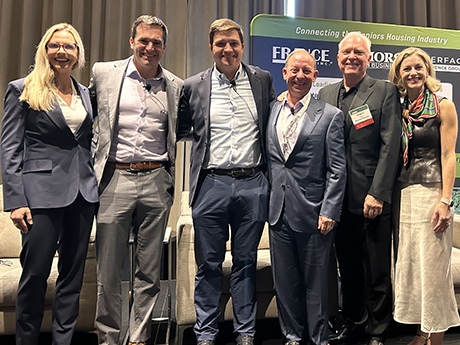
Moderated by Karla Carlson, executive vice president of Amira Senior Living at United Properties, the panel also featured Laurie Schultz, principal and co-founder of Avenue Development; Robert May, founder and managing partner of Avenida Partners; and Michael Uccellini, CEO of United Group Cos.
Courting Prospective Tenants
Though residents may be inclined to stay once they have inked leases, the lease-up process itself can pose one of the primary challenges for active adult owners and operators. Consumers can require wooing, especially when presented with the alternatives of traditional multifamily properties and aging in place at home.
“The reality of development in the active adult space is that lease-up risk is the biggest risk,” emphasized Crowe.
This risk compounds other headwinds, including high construction and labor costs. “A couple of years ago, I sat here and said that 50 percent of the deals didn’t underwrite,” recalled Levine. “I would say that number is closer to 80 percent right now.”
Lease-up rates can be slow, Schultz observed. “Leasing velocity is at five to six [units] a month,” she reported.
Whereas other types of senior living are needs-based, active adult living is strictly a matter of preference and choice, panelists outlined.
“It is really different than higher care [senior living] where there is a need,” explained May. “It is elective. They do not need to move into your building. You need to get them to want to move into your building.”
Given this dynamic, it is paramount to focus on the wants and needs of active adult residents, May added. “We came to the motto that we are ‘people serving people,’ and if you are not delivering the goods for your residents, you are not going to get those rent increases or a full building,” said May. “Communities are filled with 200 to 300 people that all have opinions and interests. They all want to be heard, and you have to learn how to serve them at that level.”
Convincing prospective active adult residents is not just a challenge at the community level, but also represents one of the collective projects for a subsector that remains relatively nascent.
“I think we’re in the early innings of active adult,” asserted Uccellini, who shared that United Group Cos. has been involved in the active adult sector since the early 2000s.
Schultz agreed that there is still a long way for the industry to go to attract more prospective residents and achieve higher penetration rates. “Consumer brand awareness around the industry of active adult keeps me up at night,” she added.
More Than Bingo
According to panelists, it is not only prospective residents who remain undereducated about active adult as an asset class. Commercial real estate professionals with limited exposure to senior living also misunderstand the nature and demands of active adult, Levine pointed out.
“Multifamily people come in thinking that active adult is multifamily with bingo,” Levine shared. “It’s been a little frustrating.”
In fact, offering amenities, hospitality and staffing at a high level is key to active adult.
Given Greystar’s multifamily portfolio, the company is well aware of the distinctions between multifamily and active adult, asserted Levine. “The difference is the human capital,” he pointed out. “Having the right people and the right feeling in that building is everything. It’s not the sticks and bricks.”
“It is very critical in active adult management and operations to have a robust lifestyle program,” Uccellini elaborated.
Though the costs and challenges are considerable, the payoff can be more than worth it, panelists agreed, pointing out that opportunities for growth and pricing premiums abound.
“We achieved a 70 percent rent premium over Class A multifamily on a deal that we did in Southwest Florida,” reported Uccellini.
“The demographics are only improving,” said an enthused Crowe. Research corroborates this point; according to the National Investment Center for Seniors Housing & Care, renters age 65 to 74 represent the fastest-growing cohort. “The fundamentals of the future are very, very bright.”