
By Matt Valley
CHICAGO — When Ken Dychtwald entered the field of aging and longevity in 1973, the joke was that a game of shuffleboard was synonymous with the elderly.
“That’s what retirees did — they played shuffleboard,” says the renowned psychologist, gerontologist and best-selling author of 19 books on aging.
Twenty-five years later, John Glenn, the famous astronaut and former U.S. senator from Ohio returned to space aboard the space shuttle Discovery at age 77, becoming the oldest person to travel to space at that time.
Leading up to the launch in 1998, some media outlets suggested Glenn would be better off playing golf, Dychtwald recalled. But the American icon pushed back, famously saying, “Just because I’m 77 doesn’t mean I don’t have a dream.”
“What Glenn was saying is if you’re going to live a long life, maybe there’s time to have a new dream, fall in love again, start up a new business, become a volunteer, join a church, or run for office — to imagine who you might want to be,” explains Dychtwald, the founder and CEO of Age Wave. Based in Orinda, California, the consulting firm focuses on longevity, aging, retirement and the economic power of the 50-plus population.
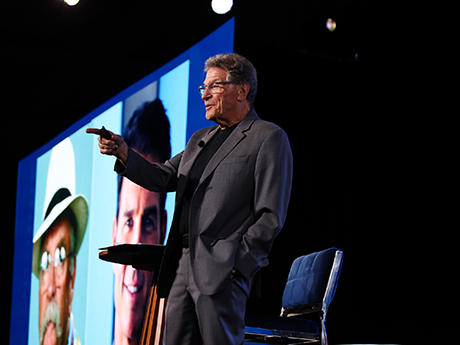
His comments came last Wednesday, Oct. 21, during the opening day of the 2026 NIC Fall Conference as part of a session titled, “Aging Reimagined: Who’s Coming Next for Senior Housing and Care?” More than 3,650 industry professionals gathered at the Sheraton Grand Chicago Riverwalk for the annual three-day conference, which featured educational programming and networking opportunities.
A consultant to many Fortune 500 companies on aging, Dychtwald shared how evolving preferences among Baby Boomers and Generation X will alter everything from service delivery to investment strategies.
Dramatic Growth in Life Expectancy
The average life expectancy at birth in the United States in 1787 — the year the U.S. Constitution was signed — was 37 and the median age was 16, according to Dychtwald. In the late 1800s, the stages of life included childhood, adulthood, and old age. By the 1970s, the stages of life had expanded to include childhood, adolescence, young adulthood, adulthood and old age.
“You guys are smack in the middle of a new frontier,” said Dychtwald. “There are three new stages of life emerging: middlescence, late adulthood and elderhood.”
He challenged the audience members to ask themselves what this new frontier does for their business plans. “Who is your market? How do you refer to them? When are people old? What is happening in middle age, late adulthood and old age? Who are the role models?”
Dychtwald, who holds a doctorate in psychology, also delivered a sobering message to owners and operators about their customers. “Take a deep breath. I’ve looked at every study in the last 10 years. Boomers don’t ever want to be a senior. I know your industry. I know the names of your companies. I know that this is seniors housing. And that worked. It may not work going forward.”
Impact of Generational Traits
Dychtwald said members of the Silent Generation (born from 1925 to1945) trust authority, follow rules, are team players and are stoic. By contrast, he cautioned seniors housing operators that baby boomers (born between 1946 and 1964) resist authority, break rules, prize individuality and are “psychodramatic.” He also noted that boomer women were the first generation of women to attend college in large numbers.
“You’ve been dealing with a generation of stoics. Get ready for the complaining. Get ready for new demands,” he remarked. Approximately 76 million baby boomers were born in the United States between 1946 and 1964, with about 69 million from that generation remaining alive in the U.S. today. By comparison, there are about 13 million members of the Silent Generation still living in the country.
In what’s being called the greatest wealth transfer in history, nearly $124 trillion in assets is set to change hands through 2048, according to projections by Cerulli Associates, a research and consulting firm specializing in wealth management.
Many people incorrectly assume that wealth will go from boomers to the next generation, Dychtwald noted. “It will go from boomer men to boomer women because the women are married to men on average two-and-a-half years older than them, and they will outlive their husbands by five to six years.”
The Gen Xers (born between 1965 and1980) were the first generation of latchkey kids, a phenomenon that peaked in the 1970s and 1980s that coincided with a spike in the divorce rate.
“The kids grew up without necessarily parental supervision. They lived through AIDS in their early years. They were the tech pioneers. Some of their traits include unease about authority, and they’re not quite sure who can be trusted. They’re individualistic. They’re comfortable with diversity,” said Dychtwald. There are approximately 65 million Gen Xers living in the U.S.
Game Changer: Technology
A third of people over 65 have five or more physicians who don’t talk to each other, pointed out Dychtwald. Polypharmacy, defined as the regular use of at least five medications, can lead to more complications or illnesses for some individuals.
In the same way Waze and Google Maps help guide drivers to their destinations safely and efficiently, Dychtwald would like to see the creation of a “Health Waze” to enable individuals to program in a 110-year-old version of themselves. Ideally, the technology would inform users about what nutrients they need or notify them when they stray from their normal sleep patterns.
“We’re seeing little bits and pieces of this with Oura rings and Fitbits, but you watch in the next few years if this doesn’t become a mainstay of our healthcare system,” said Dychtwald.
He asked the audience members if they would someday be willing to consider a $10,000 to $12,000 monthly lease fee for a 24-hour a day robot caregiver at home in lieu of a human caregiver, noting that the latter is increasingly less available and more expensive. Several attendees raised their hands.
“Yeah, I’ve been asking that question the last month or two, and I get more than half the people raise their hands. You don’t have to worry about them stealing from you. You don’t have to worry about them not showing up,” said Dychtwald of the robots.
The national median cost for 24-hour care at home is between $18,000 and $25,500 per month, according to A Place for Mom.
Why Live Alone?
The shift toward normalizing living alone came alive after World War II, according to the 76-year-old Dychtwald. “When I was a young boy, my brother and I shared a bedroom. We lived in the same house with my grandparents. Then all of a sudden, everybody got their own bedroom, their own thing: their own brand, their own website, their own influencing platform.”
Going forward, shared living or intergenerational shared living may be a viable option for some folks, Dychtwald believes. In senior shared housing, two or more unrelated older adults live together in a single residential unit or community, sharing common spaces and daily responsibilities while maintaining individual private quarters. Unlike institutional care, this model emphasizes mutual support, cost-sharing, and community-driven daily operations.
Intergenerational senior living is a residential model that intentionally houses or connects older adults with younger generations — such as college students, children or families — in the same community, building, or co-located facility to foster daily interaction and mutual support.
“Who says that everybody ought to be only with folks their own age?” Dychtwald asked.
Challenging the Industry
The Age Wave founder prefaced one of his observations of the seniors housing industry by acknowledging it would offend some people.
“To have a country where people spend their last 12 years in a cascade of poor health and people profit from that is a strange equation. So, the moral me wants people to match their healthspans to their lifespans.”
The night before his presentation at NIC, Dychtwald logged into LinkedIn. He joked that everybody who wanted to befriend him was a dementia care specialist. He then posed a question to the audience.
“Say you woke up tomorrow morning, and dementia was gone. Some of your businesses — there would no longer be a need for them. And I want you, in the quiet of your own room or [when] traveling home, to think: Is that good or bad? Who are you?”
In 2022, U.S. healthcare spending per capita was over $12,000, according to the World Health Organization, making it the highest spender on healthcare per person annually among all developed nations. Yet the U.S. has not constructed a healthcare system that creates healthy, long-lived people, explained Dychtwald.
In 2024, the U.S. ranked 88th globally in healthspan — the period of life spent in good health free of chronic pain, severe disability or debilitating illnesses. The average healthspan in the U.S. is about 64 years compared with 73 years for top-ranked Singapore.
Meanwhile, the U.S. ranked No. 61 in life expectancy in 2024, at 79 years, compared with No. 1 Monaco, at over 86 years.
“The entire aging field is oriented around helping people who are struggling in their later years financially, physically, spiritually, socially,” Dychtwald pointed out.
Dychtwald showed a short video in which he asked two leaders in the business — one on the social services side and the other an expert in geriatric medicine — what they’ve learned about the field of aging and society’s approach to it. The consensus was that the focus should be on “longevity” because it’s a much more aspirational term than “aging” and provides a life course perspective.
Near-Term Outlook
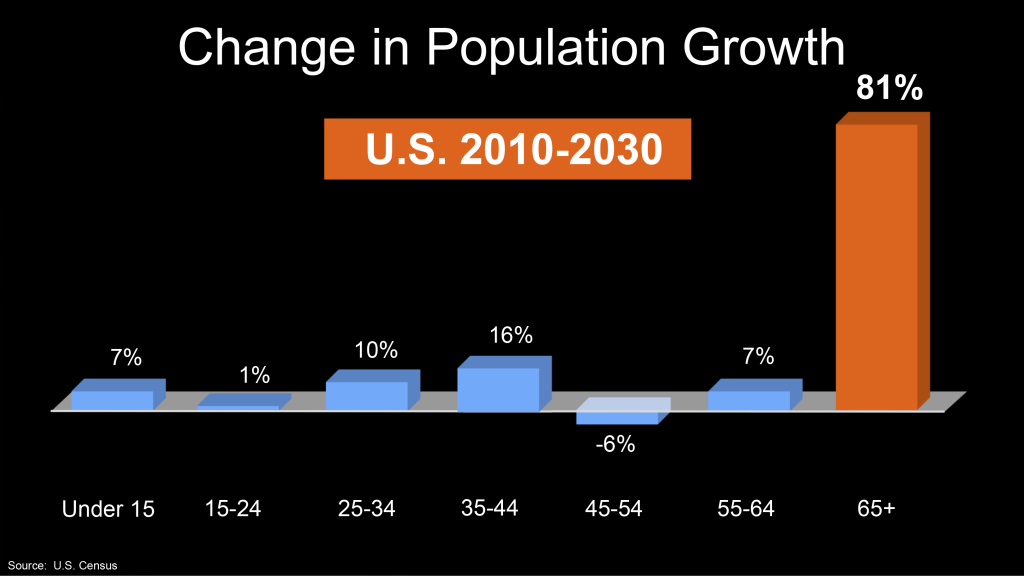
The demand for skilled nursing will continue to multiply, predicts Dychtwald. He would love to see a cure for dementia to put memory care out of business. But until that happens, he expects that segment of the business to grow along with broader assisted living sector due to the silver tsunami that’s on the doorstep (see chart on change in population growth).
“It was a very clever revising of the name: Alzheimer’s lockdown wards [to] memory care,” he noted.
Two words that Dychtwald is seeing crop up more frequently within the seniors housing industry are “well-being” and “fulfillment.”
“I know that many of you are from the investment world, and your expertise is not languaging things or coming up with creative branding platforms,” Dychtwald told the audience.
However, he emphasized that “creative maneuvering” will be essential in the transition from providing care for the Silent Generation to providing care for Boomers.