
By Matt Valley
CHICAGO — A new report on potential future seniors housing supply published by the National Investment Center for Seniors Housing & Care (NIC) reveals that there were 88,283 units in the planning pipeline across 214 NIC MAP markets in the second quarter of 2026. Of that total, approximately 95 percent were associated with new property development.

“With seniors housing construction remaining constrained and occupancy approaching high levels, attention is increasingly turning to what may come next,” the report states. “Units currently under construction provide visibility into near-term supply, but they do not capture the projects sitting further upstream in the development process.”
Lisa McCracken, who oversees NIC’s research and analytics team, summarized the highlights of the report during a press briefing on the opening day of the 2026 NIC Fall Conference at the Sheraton Grand Chicago Riverwalk hotel.
The number of registrants for this year’s fall conference totals more than 3,650, a 10 percent increase relative to one year ago and the organization’s largest attendance on record, according to NIC. Approximately 750 individuals are attending a NIC conference for the first time.
Supply-Demand Gap Grows
The industry finds itself in a unique spot with strong demographic tailwinds, but also historically low inventory growth — below 1 percent year-over-year growth for the past six quarters, says McCracken. The occupancy rate crossed the 90 percent threshold in the third quarter of this year across the 31 primary markets tracked by NIC MAP (at an average of 90.4 percent, to be exact).
NIC MAP estimates that the industry needs roughly 576,000 additional units by 2030 to meet this growing demand, noted McCraken, but she pointed out that construction starts are currently at a pace of 10,000 units annually.
“We know that on average a community takes about 29 months to plan and build. The units that need to open in 2029 really need to start breaking ground now. So, what that means is we are pretty confident what the next few years look like. The shortage is pretty much already locked in for the next few years,” said McCracken.
Among the report’s key findings were:
• Primary markets account for 71 percent of planned units, indicating a notable concentration in the largest NIC MAP markets.
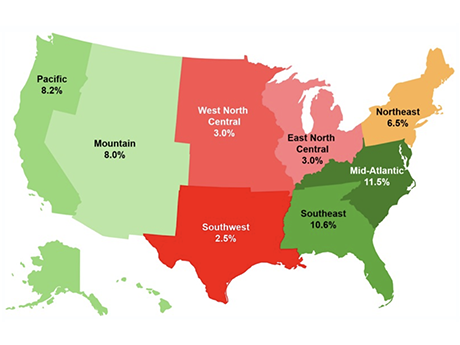
• The planning pipeline showed a coastal concentration. The Southeast, Mid-Atlantic, Pacific and Northeast regions collectively accounted for approximately 77 percent of units in various planning stages.
• As of the second quarter, just 5.5 percent of all the projects in the pipeline had reached the bidding or final planning stage. The remainder were in the pre-planning or planning stage.
• Relative to existing inventory, the planning pipeline is the largest in the Mid-Atlantic and Southeast, where planned units represent 11.5 percent and 10.6 percent of inventory, respectively.
• The Southeast region had the largest number of units (19,555) in the new property planning pipeline as of the second quarter, followed by the Mid-Atlantic (15,841), Pacific (15,364), Northeast (14,008), Mountain (6,960), East North Central (6,586), West North Central (3,221), and the Southwest (2,538).
• There were 27,184 units under construction across 214 markets as of the second quarter. (Those units represent 2.2 percent of the existing seniors housing supply. The 10-year average is 5.4 percent.)
The planning pipeline report examines the size and maturity of that pipeline and what types of projects and communities are being planned. This includes modifications to existing projects and new property development across independent living, assisted living and continuing care retirement communities.
“Importantly, the planning pipeline represents potential future supply, not a forecast for future construction or inventory growth,” the report emphasizes. “Projects may advance, be delayed or not ultimately break ground.”
To access the full report, please click here: https://www.nic.org/resources/beyond-construction-the-senior-housing-planning-pipeline/