
By Brad Schopp

Over the past several years, the seniors housing sector has faced one source of pressure after another, with little relief in between. The private-pay segment moved from overbuilding during a three-year period (2017–2019) to pandemic-driven occupancy declines and falling net operating income (NOI), problems that were exacerbated by a sharp rise in interest rates and inflation.
Skilled nursing faced many of the same pressures — albeit without the overbuilding cycle — as well as payor reimbursement volatility and labor strain.
Through the first half of 2026, valuation trends show the sector has recovered and, in general terms, surpassed prior peaks. While pricing in many markets has returned to — and sometimes exceeded — pre-pandemic benchmarks, the current valuation environment reflects more than a simple recovery.
In fact, the sector has undergone a recalibration. Higher interest rates have reset investors’ return expectations, while new supply remains historically constrained. Furthermore, improving occupancy and rent growth are driving values through operating performance rather than cap rate compression alone.
As a result, today’s pricing dynamics are being shaped by a more disciplined capital environment and structurally stronger fundamentals.
Valuation Highs and Lows
The late 2010s marked record pricing for senior living assets. According to Irving Levin Associates, assisted living assets averaged approximately $248,000 per unit in 2019, while independent living and skilled nursing also approached new highs.
Cap rates compressed amid more liquidity and historically low interest rates. Investors were underwriting long-term demographic growth and paying premium pricing for stabilized assets.
COVID-19 abruptly disrupted that momentum. Occupancies fell sharply, expenses rose and transaction activity slowed. Sales pricing declined sharply during the second and third quarters of 2020, particularly for transitional and higher leverage assets as lenders pulled back and buyers demanded wider risk premiums amid uncertainty.
Cap rates expanded, reflecting concerns around NOI durability. Skilled nursing experienced operating margin volatility tied to labor costs and reimbursement variability, creating wide valuation dispersion across states.
By 2023, rising interest rates introduced an additional headwind and created higher borrowing costs, pushing up seniors housing cap rates further. Even as occupancy began recovering, elevated debt costs impacted pricing and slowed transaction velocity.
2025: Fundamentals and Capital Reconnect
A turning point came in 2025, generating momentum that has carried into 2026. NIC MAP data illustrated seniors housing occupancy approaching or exceeding pre-pandemic norms, while new construction remained historically constrained.
Seniors housing construction activity in the second quarter of 2026 represented approximately 2.2 percent of existing inventory compared with 6.9 percent in the fourth quarter of 2019 — roughly one-third of the activity prior to the pandemic.
At the same time, capital markets began showing signs of stabilization. HUD financing activity increased, banks cautiously re-engaged, and alternative lenders expanded their footprint as operating performance improved.
Transaction activity accelerated. Irving Levin Associates reported more than 800 publicly announced healthcare real estate transactions in 2025, with disclosed volume exceeding $30 billion. According to Irving Levin’s 2025 transaction data:
- Assisted living averaged approximately $268,600 per unit
- Independent living approached $263,600 per unit
- Skilled nursing climbed above $105,000 per bed.
While these averages reflect a higher share of institutional-quality, stabilized assets trading in 2025, they also underscore that pricing has rebounded from pandemic lows. That trend has continued into 2026. NIC MAP reported roughly $13.2 billion in closed seniors housing and nursing care transactions during the first half of the year and pricing per unit near or at historic highs.
Today’s valuations are being supported less by aggressive cap rate compression and more by restored and growing NOI, signaling a healthier pricing foundation than the late-cycle dynamics of 2018 to 2019.
Public Markets as a Leading Indicator
Public market performance reinforces improving investor sentiment. Between Dec. 1, 2023 and Aug. 7, 2026, Brookdale Senior Living’s stock price increased approximately 165.8 percent. Welltower’s stock price rose 164.8 percent during the same period, while Ventas’ share price climbed 99.7 percent, based on daily closing prices.
These are equity, or share-price, gains. On an enterprise-value basis, which also accounts for debt, the repricing is more measured, particularly for a leveraged operator such as Brookdale, whereas for a lightly leveraged owner such as Welltower, equity and enterprise value have moved largely in step.
Public equity markets often move ahead of private transactions, and the magnitude of recent gains across both REITs and operators suggests sustained confidence in forward-NOI growth and long-term demographic demand. The sharp repricing of public seniors housing equities has helped reduce the valuation disconnect that existed in 2022 and 2023, contributing to new momentum across institutional portfolios.
What Changed?
The most significant shift has been the alignment of NOI growth with constrained new supply. U.S. Census Bureau projections show that the 75-and-older population is entering its fastest growth phase in decades. Annual growth rates are accelerating from roughly 2 percent (2010–2020) to a projected 4 percent for 2026–2031. At the same time, elevated construction and financing costs have limited development activity.
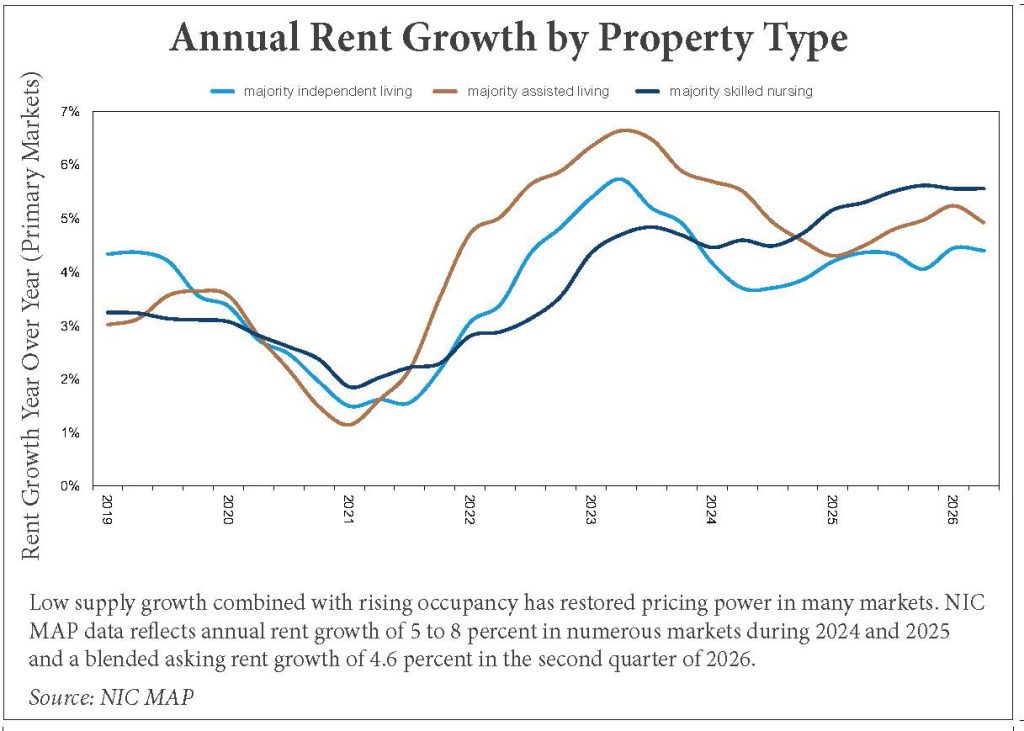
Low supply growth combined with rising occupancy has restored pricing power in many markets. NIC MAP data reflects annual rent growth of 5 to 8 percent in numerous markets during 2024 and 2025 and a blended asking rent growth of 4.6 percent in the second quarter of 2026. With development pipelines remaining well below prior cycle peaks, sustained occupancy strength is expected to support continued revenue growth.
Capital Markets Implications
For investors, the current environment presents both opportunity and a call to discipline. Owners who navigated the pandemic are seeing asset values restored, creating recapitalization and exit opportunities. Buyers must justify higher entry pricing through credible NOI growth assumptions rather than relying on cap rate compression alone.
Debt markets remain more disciplined than in the prior cycle. Leverage levels are generally more conservative, spreads over benchmark rates remain elevated relative to 2019, and lenders are focused on durable cash flow coverage.
The average U.S. 30-year fixed rate for single-family residential mortgages briefly dipped below 6 percent in late February 2026, touching 5.98 percent, its first move into the 5 percent range in more than three-and-a-half years, before reversing course amid renewed inflation concerns and geopolitical uncertainty. By early August 2026, the 30-year fixed rate had climbed back to 6.69 percent, according to Freddie Mac’s Primary Mortgage Market Survey.
While seniors housing transactions are financed with commercial debt rather than residential mortgages, the recent volatility in long-term rates reflects capital market conditions that remain in flux, with borrowing costs still elevated relative to the prior cycle and borrowing costs a continued swing factor for pricing and transaction activity.
HUD financing continues to play an important role, particularly for stabilized assets, while banks and alternative lenders are selectively reentering the space.
Implications for Operators and Developers
Higher valuations raise performance expectations. Revenue growth has returned, but labor costs remain elevated, even as pressures from high-cost temporary staffing agencies have moderated.
Regional wage disparities continue to drive margin differences and valuation dispersion. Sustained NOI growth — and therefore value — will depend on operational efficiency, disciplined staffing and strategic pricing.
Despite rising asset values, development remains selective. Construction costs and financing rates have materially altered
feasibility thresholds. Projects pencil out in certain growth markets but remain challenged in higher cost coastal metros. Constrained
supply, however, supports occupancy and pricing strength for existing assets.
Outlook
The valuation cycle seen from 2017 to 2026 reflects a full reset, as opposed to a simple rebound.
Cap rates may remain above pre-pandemic lows, but improved NOI visibility, demographic acceleration and limited new supply provide a more stable foundation for long-term value creation.
Seniors housing and skilled nursing have emerged from a period of volatility with improving fundamentals and renewed capital engagement.
In this next phase, disciplined underwriting, operational execution and thoughtful capital structuring will determine who captures the sector’s demographic tailwinds most effectively.
Bradley J. Schopp, MAI, is a national practice leader of Integra Realty Resources’ Healthcare & Senior Housing Practice Group and executive director of IRR’s St. Louis office. He is also a co-author of “The Appraisal of Senior Housing, Nursing Home, and Hospital Properties.”