By Beth Mattson-Teig Real estate investment trusts (REITs) have their foot firmly on the gas when it comes to acquiring seniors housing assets, and they’re taking full advantage of the opportunity to buy at below replacement cost. The appetite to grow portfolios, particularly on the private pay side of independent living, assisted living and memory care, comes as no surprise given the combined tailwinds of growing consumer demand and a slowdown in new supply. While the aging population has led to accelerating demand, the high cost of development has forced …
Features
By Jane Adler Similar macro trends are shaping both seniors housing and skilled nursing. The aging population continues to increase demand for services. Occupancies are rising. Limited new development has helped to keep competition in check. Meanwhile, technology promises to improve operational efficiency and potentially cut expenses. Industry consolidation is ongoing. Older buildings are being renovated. Prices for quality properties are rising, and investors are eager to invest in both seniors housing and skilled nursing. Both segments face similar challenges too. Although the worker shortage has eased somewhat, operators continue …
By Matt Valley The seniors housing lending market hasn’t made a 180-degree turn from a year ago when the Federal Reserve was at the peak of its monetary tightening cycle, Fannie Mae and Freddie Mac were dealing with plenty of asset management issues on their balance sheets and the loan underwriting practices of banks were quite stringent. But the debt financing market has clearly turned a corner and is headed in the right direction, even as developers remain frustrated. That is one of the big takeaways from InterFace Seniors Housing …
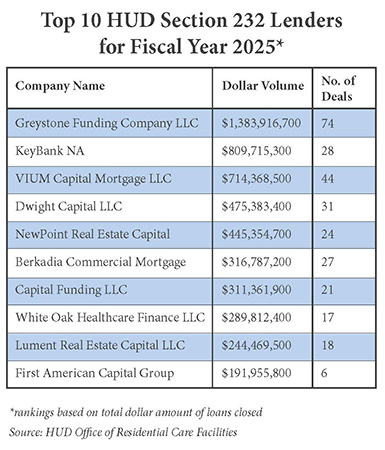
By Matt Valley There are two major takeaways from the U.S. Department of Housing and Urban Development’s healthcare mortgage insurance program more than halfway through fiscal year (FY) 2025. First, loan volume is on a pace to significantly surpass the $3.1 billion figure recorded in FY 2024, likely reaching $4 billion or more. Second, the launch of the Department of Government Efficiency (DOGE), which aims to reduce government spending, led to several employee departures at HUD at a time when there was already a backlog of loans to process. The …
Emergency Ready: Promote Resilient Life Safety Programs in Senior Communities
In seniors housing, safety isn’t just a protocol; it’s a promise. With residents and their loved ones relying on clear communication and quick responses, creating and maintaining a robust emergency action plan (EAP) tailored for senior living communities is essential. From fires and severe weather to power outages and elevator malfunctions, preparation and well-tested systems can help to keep seniors safe and cared for, while reassuring families and reducing property risk. Here’s how owners and operators can build a safer, more responsive environment for residents, staff and families alike. EAP: …
By Hayden Spiess CHICAGO — Philip Kroskin, head of real estate and senior vice president of investments with Sunrise Senior Living, has a message for those who are reluctant to invest in seniors housing development: “Why are you being so stupid?” Kroskin’s blunt question came during a recent two-day InterFace event at the Swissotel Chicago. Taking place June 24-25, the InterFace Seniors Housing Midwest conference drew 215 attendees and featured a number of panel sessions. Joining Kroskin on stage for a panel titled “When Will Development Rebound?” during the first evening …
By Jane Adler Seniors housing properties are aging almost as fast as the older population. The first baby boomers, who were born in 1946, turn 80 next year. That’s prime time for senior living. Projects from the first big development wave in the late 1980s are now approaching the 40-year mark — hardly prime time for a commercial building. With construction starts remaining at historic lows, strategies are emerging to align the growing demand for senior living with an aging building stock. Owners are reinvesting in older properties. Full-scale renovations …
By Bob Hankin Over the past several years, sustainability and energy efficiency have been key differentiators and quality indicators within the multifamily housing industry. However, the seniors housing industry has been slower to adopt these priorities — despite the benefits for residents’ health and wallets (which is particularly important for seniors living on a fixed income). From smart building technology to building design techniques, innovations in environmentally conscious development have the potential to transform the senior living experience, while also reducing long-term costs for developers and ensuring a better tomorrow …
By Hayden Spiess DALLAS — Even those in their golden years are not immune to climbing rates of marriage dissolution. The divorce rate among couples wherein one of the spouses is age 50 or older — a phenomenon sometimes termed a “gray divorce” — has risen to 40 percent, according to data from the National Investment Center for Seniors Housing & Care (NIC). Though a bleak statement on the marital landscape, this fact has been one of the elements bolstering occupancy within the growing active adult subsector of seniors housing, says Caroline …
Webinar: Seniors Housing Shift — How Underwriting, Valuation, and Capitalization are Changing
The June 5 webinar “Seniors Housing Shift: How Underwriting, Valuation, and Capitalization Are Changing” brought together industry leaders to share insights on evolving investment strategies, lending dynamics and value trends across the seniors housing sector. Sponsored by Blueprint, the session offered expert commentary on a transforming market as operators and capital providers recalibrate while costs, occupancy, margins and interest rates stabilize. The panel examined shifts in underwriting assumptions, investor return expectations and the availability of both debt and equity capital. With a focus on market fundamentals and practical strategies, the …