
By Hayden Spiess
CHICAGO — New players are increasingly drawn to the seniors housing sector due to strong market fundamentals and the industry’s proven performance. Limited new inventory and high occupancies, along with a robust population of aging individuals and rent growth, are generating healthy returns for investors.
“The fundamentals have never been stronger,” says Tom Errath, managing director and head of research at Harrison Street Asset Management.
Harrison Street itself is no new player when it comes to senior living. The firm has acquired roughly $15 billion worth of seniors housing assets since its inception in 2005. In the past 18 months alone, Harrison Street has sold $3 billion and acquired $2 billion of assets within the sector.
Seniors housing is the firm’s “highest-conviction [sector] right now,” states Errath.
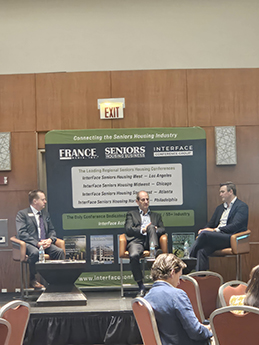
His comments came during the keynote session at the InterFace Seniors Housing Midwest conference on June 24. Held at the Embassy Suites Magnificent Mile hotel, the annual event drew approximately 200 attendees.
Editor’s note: InterFace Conference Group, a division of France Media Inc., produces networking and educational conferences for commercial real estate executives. To sign up for email announcements about specific events, visit www.interfaceconferencegroup.com/subscribe.
Errath was joined onstage by his colleague Rob Korslin, senior managing director at Harrison Street, and session moderator Richard Kelley, publisher of Seniors Housing Business.
Korslin and Errath observed that the commercial real estate industry at large seems to share Harrison Street’s enthusiasm for the senior living sector. As a result, merger and acquisition activity is robust and gaining momentum.
“Transaction activity in the first quarter of this year was $10 billion,” noted Korslin, pointing out that this deal volume far outpaces the level of activity during the same period two years ago. According to NIC, transaction volume for the sector hit nearly $27 billion in 2025, up from $17.3 billion in 2024.
The keynote speakers predicted that this trajectory will continue, even as development restarts.
Froth Free
Early in the conversation, Korslin asserted that he has an uncanny ability to sense when a sector is being overvalued by investors. “I have been investing in commercial real estate for close to 15 years now,” he shared. “I’ve gotten a ‘Spidey sense’ on market frothiness.”
None of that frothiness is found in the current landscape of senior living, though, which boasts the most compelling supply-demand setup in commercial real estate, according to Korslin.
“Our core fund, which owns a trophy portfolio of seniors housing assets around the country, saw 16 percent growth in same-store net operating income in the first quarter,” shared Korslin. “It’s pretty tough to make a bear case on the demand side.”
According to the National Investment Center for Seniors Housing & Care (NIC), seniors housing occupancy nationally reached 89.5 percent in the first quarter of 2026, marking the 19th consecutive quarter of occupancy rate increases.
“We’re seeing demand for 50,000 units a year nationally, and we’re delivering 16,000 or 17,000 units,” said Errath, referring to the supply/demand imbalance nationally.
Other entities, including REITs, have increasingly taken notice of the strong consumer demand for seniors housing. This has generated an increased appetite for investing in properties and contributing to the uptick in acquisitions and dispositions. “Everybody now is chasing seniors housing,” proclaimed Korslin.
Kelley asked the Harrison Street executives about the “100-pound gorillas” — publicly-traded companies like Welltower, Ventas and the newly formed Janus Living (NYSE: JAN), a seniors housing REIT created by Healthpeak Properties. “How do they impact things?” he posed.
“They have been buyers of our portfolios,” responded Errath. “We definitely like them.”
Korslin confirmed that Harrison Street has sold large portfolios to REITs. He added that contrary to feeling threatened by other players in the seniors housing sector, his firm sees enthusiasm from other investors as beneficial.
“It’s great to have that public investment in this space,” he says. “At a macro basis, we’re going to be undersupplied in a very acute way in a short time, so more institutional capital flowing into the space is good for everybody.”
Executing Deals with Discipline
Both Korslin and Errath cautioned that despite seniors housing’s positive real estate fundamentals and tailwinds, new investors should not enter the space blindly.
“In our 20 years of experience and close to 400 assets in our history, we’ve learned a lot of lessons,” pointed out Korslin. “It’s still a very operationally intense business, more so than any other real estate class.”
For this reason, the keynote speakers said it is paramount that owners be prudent when selecting operators.
“A lot of our key operating partners are ones we’ve worked with for 10 or 15 years,” said Errath “and we very carefully bring one or two [operators] on every couple of years. We’re bringing a new one on right now.”
Harrison Street exhibits a similar level of judiciousness when purusing acquisition opportunities, preferring high-barrier-to-entry and high-income markets.
“Our screening is based on very specific metrics that, from a market perspective, have correlated to success in our track record,” outlined Korslin. “As a result, we focus on typically affluent [markets], where there is pricing power and real supply barriers.”
That same discretion is also applied to Harrison Street’s development projects, which the executives said have continued despite high construction costs and expensive financing.
In the markets that Harrison Street focuses on, the firm has developed more than 30 percent of all new supply since the onset of the COVID-19 pandemic in early 2020, according to Korslin.
“We intend to continue to be a consistent provider of development in seniors housing,” he continued. “From 2025 through the end of this year, we will probably have gone vertical on 10 to 15 projects, so we’re very active today.”
Errath and Korslin predict that construction activity will continue to increase over the next few years.
“People are starting to buy assets above replacement cost, so that’s a green light for the development pipeline,” Korslin observed.
Even as the pace of development begins to pick up, the two Harrison Street executives do not anticipate that an uptick in new supply will put a damper on merger and acquisition activity, at least for the foreseeable future.
“The demand for seniors housing investment is going to continue to outweigh the supply of opportunities out there,” forecasts Korslin. “Next year, I think we’re going to be in the same spot or even more optimistic.”